|
[left.htm]
| |
|
Introduction
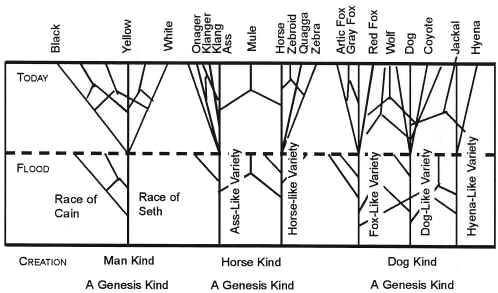
Definitions are a good place to begin. What is “evolution”? When the evolution versus creation debate started in the 1800s, the ground rules were clear. At that time the issue was plain and simple. Everybody knew Genesis recorded all the cattle, creeping things and beasts of the earth reproduced “after his kind.” There was the “dog kind;” there was the “horse kind.” A “specie” was understood by all to be a “Genesis kind.”
The question was—Did a one-cell living organism evolve in complexity from one Genesis kind to another Genesis kind and finally culminate in humankind? Now evolutionists have changed the rules. They changed “specie” to refer to minute classifications of possible variation within the Genesis kind.
After decades of experimentation, scientists have produced many exotic varieties of
fruit flies. Each variety has been designated a “specie.” As a result, some claimed they proved evolution from one specie to another. But it remained self-evident that all the numerous varieties were still
fruit flies. What they did prove was a sort of “micro-evolution” within a Genesis kind. A change from one Genesis kind to another Genesis kind—a macro-evolution—was not demonstrated.
This variation within a specie, a Genesis kind, is now what is commonly referred to as “evolution” and applied to validate Darwinism. Unfortunately, most evolutionists who make these spectacular claims of evidencing evolution are the popular writers of books and articles for the general public and our schools. Jonathan Weiner’s book, the
Beak of the Finch: A Story of Evolution in our
Time, is a case in point. Weiner wrote about his time in the Galapagos Islands with two scientists who study finches.
Darwin had made many of his observations on the same island. These observations became the basis of his book,
The Origin of Species. The distinctive characteristic of what has come to be known as “Darwin’s finches” is that their beaks change up to five percent in size from time to time due to environmental changes.
A New York Times book review (May 15, 1994) of Weiner’s book began by degrading Biblical creation advocates for not being aware of the overwhelming proof for evolution that had been discovered. The review then praised Weiner for demonstrating that evolution is not just a theory about changes that occurred in the remote past, but a process that we can watch because it is going on all around us all the time. However, the ironic twist about the “Darwin's finches” saga is that Charles Darwin, who first discovered variations within the finches at the Galapagos Islands, did not himself use this beak variation factor as a proof of his evolution theory. Why?
This variation was only the minimal micro-evolution changes within a fixed Genesis kind or specie. Darwin’s evolutionary theory not only requires numerous genetic changes within a Genesis kind, but an evolving from one Genesis kind to another. For example, a fish would eventually become the progenitor for a horse somewhere down the line.
On the other hand, how reasonable for a master-mind Creator to design fixed classifications of
specie with genetic possibilities for variation within its kind. Science validates this rigidity between true Genesis-kind
specie. If evolution claims changes from one specie to another specie, the theory cannot be proved by simply redefining what a specie is!
|
|
Molecular Evidence
Darwinists
Confirm
God Created Man
Chapter One
With the enormous advances in biochemistry, a relatively new discipline is being developed by evolutionists. The principal molecular components of the “biological cell” are proteins—which consist of a long chain of amino acids in a specific sequence—and the molecular sequences of the DNA and RNA molecules. Different techniques are employed to measure the
divergence in these molecular sequences. Accordingly, biochemists are classifying
specie and larger groups by their degree of similarity at the molecular level. But the validity of these classifications so obtained is a point of controversy even among evolutionists.
Darwin Caught in a Mousetrap
While Darwinists were playing games with biochemistry, Michael Behe confronted them with a challenge that has left them reeling. This greatest scientific challenge yet to Darwinism was capsulated in a
Christianity Today article as follows:
During the fall of 1996, a series of cultural earthquakes shook the secular world with the publication of a revolutionary new book, Michael Behe’s
Darwin’s Black Box: The Biochemical Challenge to
Evolution. The reviewer in the New York Times book review praised Behe’s deft analogies and delightfully whimsical style, and took sober note of the book’s radical challenge to Darwinism. Newspapers and magazines from Vancouver to London, including
Newsweek, The Wall Street Journal, and several of the world’s leading scientific journals, reported strange tremors in the world of evolutionary biology.
The Chronicle of Higher Education, a weekly newspaper read primarily by university professors and administrators, did a feature story on the author two months after his book appeared. The eye-catching headline read, “A Biochemist Urges Darwinists to Acknowledge the Role Played by an Intelligent Designer.” (1)
With his book realizing multiple printings, Behe is popular on the university-speaking circuit. In a typical lecture, Behe projects on a screen his favorite quote by Darwin from
The Origin of Species:
If it could be demonstrated that any complex organ existed which could not possibly have been formed by numerous, successive, slight modifications, my theory would absolutely break down. (2)
Behe takes on Darwin’s challenge by asking, “What type of biological system could not be formed by ‘numerous, successive, slight modifications’? Well, for starters, a system that has a quality that I call irreducible complexity.”(3) Next, Behe flashes on the screen his hallmark illustration of “irreducible complexity”—a mousetrap! After observing that all five parts of the trap are simultaneously essential for performance, Behe adds:
You need all the parts to catch a mouse. You can’t catch a few mice with a platform, then add the spring and catch a few more, and then add the hammer and improve its function. All the parts must be there to have any function at all. The mousetrap is irreducibly complex. (4)
Next Behe explores the ultra-complex world of molecular machinery and cellular systems. He describes the chemical chain reaction that gives rise to vision, details the elegant but complex structure of the
whip-like cilium with which many kinds of cells are equipped, and then observes the extremely complicated mechanism by which blood is formed (see Appendix). Behe’s logical and eloquent conclusions are summarized:
To Darwin, the cell was a “black box”—its inner workings were utterly mysterious to him. Now, the black box has been opened up and we know how it works. Applying Darwin’s test to that ultra-complex world of molecular machinery and cellular systems that have been discovered over the past 40 years, we can say that Darwin’s theory has “absolutely broken down.” (5)
With that observation of cell complexity, Darwin is caught in Behe’s mousetrap! Behe presses his point further:
As you search the professional literature of the last several decades looking for articles that have been published even attempting to explain the possible Darwinian step-by-step origin of any of the systems, you will encounter a thundering silence. Absolutely no one—not one scientist—has published any detailed proposal or explanation of the possible evolution of any such complex biochemical system. And when a science does not publish, it ought to perish. (6)
Behe’s only conclusion is that everywhere we look inside the cell, evidence is staring scientists in the face that suggests the systems were directly designed by an intelligent agent. The only answer mustered by evolutionists to Behe is:
You’re giving up too soon. Biochemistry is in its infancy. These systems were discovered just 20 or 30 years ago. Within the next few years, we may begin to figure out how all these systems evolved.
Behe’s ready reply is:
Actually, many of these systems have been fully understood for 40 years or more, and not one explanation has been published offering a plausible scenario by which they could have evolved. Any science that claims to have explained something, when in fact they have published no explanation at all, should be brought to account. (7)
The “intelligence” behind such marvelous “irreducibly complex systems” in nature, of course, is God. How infinitely more complex the human cell, the eye or the brain—than a mousetrap! How wonderfully and poetically the Psalmist expressed appreciation of his Intelligent Creator who engineered the most beautiful of systems:
Thou it was who didst fashion my inward parts; thou didst knit me together in my mother’s womb, I will praise thee, for thou dost fill me with awe; wonderful thou art, and wonderful thy works. Thou knowest me through and through: my body is no mystery to thee, how I was secretly kneaded into shape and patterned in the depths of the earth. Thou didst see my limbs unformed in the womb. . .day by day they were fashioned, not one of them was late in growing. How deep I find thy thoughts, O God, how inexhaustible their themes! (8)
Darwinists Prove Man Was Created
A recent study by evolutionary biologists Dorst (Yale), Akashi (University of Chicago) and Gilbert (Harvard) disproved the premise of evolution. Their study left evolutionists reeling. In their quest for the ancestry of humans, these scientists probed for genetic differences in the Y chromosome of 38 men of different ethnic groups living in different parts of the world. To their amazement, Dorit and his team found
no nucleotide differences at all in the nonrecombinant part of the Y chromosomes. This lack of deviation verified that no evolution has occurred in the male ancestry of humans. Stunned by these unexpected results, Dorit and his associates did a statistical analysis to determine whether the 38 men sampled somehow inaccurately represented the male population of the earth. They were forced to conclude that man’s forefather was a single individual—not a group of hominids—who lived no more than 270,000 years ago.(9)
The Bible account of creation is vindicated by scientists. God created Adam, father of the human race. Also, the “no more than 270,000 years” is an interesting retraction from wilder speculations of millions of years. Still, the molecular clock is
a priori geared to an evolutionary time frame of history—without consideration of the Biblical time frame.
This study was devastating to Darwinists. Shortly thereafter, an American molecular biologist, Michael Hammer, examined 2,600 nucleotide base pair segments of the Y chromosomes in 16 ethnically distinct groups. His results indicated that all descended from one man living as recently as 51,000 years ago.
A British team of geneticists studied 100,000 nucleotide based pairs in five ethnically distinct groups. The results were even more compatible with the Bible. Humans are descendants from one man who lived, according to their calculations, 37,000-49,000 years ago.(10) A few more careful studies and scientists’ molecular time clock will agree with the Biblical time frame of history.
Another study was conducted in 1987 on the mitochondrial DNA, which is only passed in the female line from mother to daughter. The conclusion of this study was that all contemporary humans are descendants of one woman (whom ironically they call “Eve”), living less than 200,000 years ago. This study observed a very
slight variation on the sampling of women, in contrast to
no variation on the men. The study on women may indicate the possibility of slight micro-evolution. Therefore, the male study harmonizes with the Genesis account of creation. Males have a singular origin—Father Adam—whereas this is not true of women. Eve was created from Adam, which accounts for the slight variation in the mitochondrial DNA of women.
Darwinian biochemists face another big problem when the Y chromosome of humans is compared with the Y chromosome of chimpanzees, gorillas and orangutans. Large genetic variations occur between these
specie. Yet within each specie very little, if any, variation is found. According to Darwinists, all modern primates evolved from a common ancestor 7 to 20 millions of years ago. If this model is correct, less genetic variation between modern primates should be identifiable and greater variation within these
specie. But the opposite was true. Darwinists employ every rationale to counter these findings, but the facts stand for themselves.
Recent research on Neanderthal has challenged the Darwinists’ arbitrary evolutionary sequence of hominids. In 1996 anthropologists Jeffrey Schwartz and Ian Fattersall examined more than a dozen Neanderthal skulls. They found nasal bones and sinus cavities many times larger than modern man’s—and no tear ducts. Their conclusions could cause tears for evolutionists! Why? They asserted that anatomical differences eliminates Neanderthal from the line of human ancestry!
The final blow to Neanderthal was struck by Darwinists in 1997. Darwinist molecular researchers recovered DNA from a Neanderthal fossil and decoded it to compare how closely it resembled human DNA. Their conclusions—the human face is neither descended from nor related to Neanderthal
specie. This blow to Darwinism startled the world. The news was heralded by
Newsweek (July 21, 1997, V. 130, p. 65) with a picture of Neanderthal on its front cover.
The Darwinists’ “molecular clock” is beginning to look more like the “Genesis clock.” Molecular research confirms what would reasonably be expected of a creation model.(11)
And the LORD God formed man of the dust of the ground and breathed into his nostrils the breath of life; and man became a living soul. . .And the LORD God caused a deep sleep to fall upon Adam and he slept: and he took one of his ribs, and closed up the flesh instead thereof; and the rib, which the LORD God had taken from man, made he a woman, and brought her unto the man.(12)
|
|
Who Fine-Tuned the Universe
for Life on Earth?
Chapter Two
“In the beginning, God created the heavens and the earth.
And the earth was without form and void:
and darkness was upon the face of the deep. . .”
Genesis 1:1-2
In the first verse of the Bible, God created the heavens and the earth. The second verse describes this earth that “was” in existence for an undisclosed period of time. It was in a primitive, unprepared state. Not until the third verse does the work of the first creative day commence. It is important to notice that the work on the first creative day was not the creation of the earth itself, but God causing light to penetrate the
“darkness on the face [surface] of the deep [the waters that already covered the unfinished earth].”
The work of the seven creative days did not begin until the third verse. Because the creation of the heavens and the earth was before the seven creative days, the first two verses are not within the time frame of the seven creative days. Thus the actual age of the
“heaven [universe] and earth” are not indicated. Between the creation of the heaven and earth and the commencement of the seven creative days, the earth
“lie waste” (1) and was “empty” (2) of life for an undesignated period of time. These two characteristics of the formless earth—waste and empty of life—only anticipated the coming work to be accomplished on the seven creative days.
This global waste would have to be transformed into a habitable host planet capable of sustaining life. After this point, all the life forms up to and including humans would be created and placed in their respective ecological niches.
For the scriptural reasons already considered, therefore, the length of the seven creative days in no way indicates the age of the universe—or even that of our planet earth. Theories about a “young
Earth” or an earth billions of years old are not relevant to the Genesis account of the seven days of creation. Therefore, speculations of science as to the age of the universe and earth do not pertain to the length of the seven creative days. The Biblical account of creation welcomes the support of science, but when the Bible does not even present a precise age of the universe or earth, such attempts at agreement are not to be sought. Nevertheless, the theories of science fluctuate. The Biblical account stands on its own.
Age of Universe and Planet Earth
Certain other scriptures, as a matter of fact, indicate that the universe and the earth have existed for a long period of time. The Psalms compare the antiquity of the founding of the earth as a suitable metaphor for God's existence from eternity (Psalms 90:1,2). “Lord. . .before the mountains were brought forth, or ever thou hadst formed the earth and the world, even from everlasting to everlasting, thou art God.” If the forming of the earth is compared to God, from everlasting to everlasting, a very ancient earth is suggested. The
Earth, indeed, did exist long before its preparation for life began.
Proverbs (8:22-23) compares “wisdom” as existing for a long time before the earth was created:
The Lord possessed me in the beginning of his way,
before his works of old. I was set up from everlasting,
from the beginning, or ever the earth was. . . .
Whether “wisdom” is applied in these verses to the literal wisdom of God or to the Son of God as the personification of wisdom, the logic of these verses is that the wisdom of God has existed for an extremely long period of time. Why? Because the wisdom of God was in existence
before the heavens and the earth were created. If the universe and the earth are only 6,000 or 7,000 years old, as some believe, the logic of these verses is meaningless. A comparison of just more than six millennia is not very long. A young universe and earth of only 6,000 years old is more absurd than the many arbitrary speculations of phenomenal lengths of time.
The Conclusions of Scientists
Many of the recent discoveries of the universe support Biblical creation. Ironically, some of these discoveries were made by scientists pursuing their atheistic quests to prove evolutionary life on many of the other planets of the universe. Religion, to the scientists, was the “opiate” of the superstitious and weak. Naturalistic evolution was supposed to be the reality of the brave who dared chart the unknown. What a shocking disappointment!
The eminent cosmologist, Fred Hoyle, aggressively opposed theism and Christianity.(3) But Hoyle discovered that an incredible fine-tuning of the nuclear ground state energies for helium, beryllium, carbon and oxygen was necessary for any kind of life to exist. If the ground state energies of these elements proportioned to each other were just four percent higher or lower, there would be insufficient oxygen or carbon for life anywhere in the universe, including the planet Earth.(4)
This fine-tuning forced Hoyle to conclude—a super intellect
has “monkeyed” with physics, as well as with chemistry and biology.(5) Another scientist, Paul Davies, who once promoted atheism, now promotes “ingenious design.”(6)(7) In his own words:
[There] is for me powerful evidence that there is something going on behind it all. . . .It seems as though somebody has fine-tuned nature’s numbers to make the Universe. . . .The impression of design is overwhelming.(8)
Astronomer George Greenstein wrote in his book,
The Symbiotic Universe:
As we survey all the evidence, the thought insistently arises that some supernatural agency—or, rather, Agency—must be involved. Is it possible that suddenly, without intending to, we have stumbled upon scientific proof of the existence of a Supreme Being? Was it God who stepped in and so providentially crafted the cosmos for our benefit?(9)
The theoretical physicist, Tony Rothman, concluded a popular level essay as follows:
The medieval theologian who gazed at the night sky through the eyes of Aristotle and saw angels moving the spheres in harmony has become the modern cosmologist who gazes at the same sky through the eyes of Einstein and sees the hand of God not in angels but in the constants of nature. . . .When confronted with the order and beauty of the universe and the strange coincidences of nature, it’s very tempting to take the leap of faith from science into religion. I am sure many physicists want to. I only wish they would admit it.(10)
In an article on the anthropic principle (that the universe must have properties that make inevitable the existence of intelligent life), cosmologist Bernard Carr wrote:
One would have to conclude either that the features of the universe invoked in support of the Anthropic Principle are only coincidences or that the universe was indeed tailor made for life. I will leave it to the theologians to ascertain the identity of the tailor!(11)
Physicist Freeman Dyson, also dealing with the anthropic principle, concluded:
The problem here is to try to formulate some statement of the ultimate purpose of the universe. In other words, the problem is to read the mind of God.(12)
MIT physicist and former president of the Association of Women in Science, Vera Kistiahowsky, commented,
The exquisite order displayed by our scientific understanding of the physical world calls for the
divine.(13)
Arno Penzias, who shared the Nobel prize for physics for the discovery of cosmic background radiation, was quoted as follows:
Astronomy leads us to a unique event, a universe which was created out of nothing, one with the very delicate balance needed to provide exactly the conditions required to permit life, and one which has an underlying (one might say “supernatural”) plan.(14)
Even before Communism fell, Alexander Polyakov at Moscow’s Landau Institute said:
We know that nature is described by the best of all possible mathematics because God created it. So there is a chance that the best of all possible mathematics will be created out of physicists’ attempts to describe nature.(15)
Fang Li Zhi, China’s noted astrophysicist, and Li Shu Xian, physicist, wrote:
A question that has always been considered a topic of metaphysics or theology—the creation of the universe—has now become an area of active research in physics.(16)
Cosmologist Edward Harrison evaluated the end conclusion of cosmology:
Here is the cosmological proof of the existence of God—the design argument of Paley—updated and refurbished. The fine-tuning of the universe provides prima facie evidence of deistic design. Take your choice: blind chance that requires multitudes of universes or design that requires only one . . . Many scientists, when they admit their views, incline toward the teleological or design argument.(17)
The winner of the Crafoord Prize in astronomy, Allan Sandage, related his recognition of God:
I find it quite improbable that such order came out of chaos. There has to be some organizing principle. God to me is a mystery but is the explanation for the miracle of existence, why there is something instead of nothing.(18)
Robert Griffiths, who won the Heinemann Prize in mathematical physics, described the physicist’s encounter with God:
If we need an atheist for a debate, I go to the philosophy department. The physics department isn't much
use.(19)
The agnostic astrophysicist, Robert Jastrow, narrated the ironic twist of his colleagues’ research of the universe:
For the scientist who has lived by his faith in the power of reason, the story ends like a bad dream. He has scaled the mountains of ignorance; he is about to conquer the highest peak; as he pulls himself over the final rock, he is greeted by a band of theologians who have been sitting there for centuries.(20)
|
|
The Fingerprints of God
Chapter Three
In their quest to find evidence of
self-starting evolutionary life, scientists have found
fingerprints all over the universe—the fingerprints of God.
Fine-tuned laws govern the universe and solar system all for the
purpose of permitting life to flourish on the Earth. Earth is a
habitable home for man because of intelligent design.
Parameters for Life on Earth
Scientists actually identified over 188
parameters within our solar system and 38 parameters elsewhere in
the universe. Each of these parameters is so exacting that they
could not happen by chance. For example:
If the strong nuclear force were decreased
as little as two percent, multi-proton nuclei would not hold
together. Hydrogen would be the only element in the universe
because the hydrogen atom has only one proton and no neutrons in
its nucleus.
If the strong nuclear force were increased
as little as two percent, protons and neutrons would attach to
many other protons and neutrons. There would be no hydrogen—only
other heavy elements. Life chemistry cannot exist without
hydrogen, yet it needs more elements than hydrogen.
If the gravitational force were decreased,
stars would be so cool that nuclear fusion, the burning mechanism
in the core of stars, would not ignite.
If the gravitational force were increased,
stars would be too hot and burn up quickly and unevenly.
If the mass density—the approximately
hundred billion trillion stars of the universe—was decreased,
the
universe would contain only hydrogen and helium.
If the mass density of the universe was
increased, the universe would contain only elements heavier
than iron. The carbon, oxygen and nitrogen necessary for life are
only possible in a vast universe with billions of stars.
If the electromagnetic force were increased
or decreased, there would be insufficient molecular bonding.
Unless the number of electrons is equivalent to the number of
protons to an accuracy of one part in 1040 or better,
electromagnetism in the universe would have so overcome
gravitational forces that galaxies, stars and planets could never
have come into existence. One part in 1040 has been illustrated as
follows:
Cover the entire North American continent
with dimes stacked up to the moon (230,000 miles). Make a
million other piles of dimes of equal size. Paint one dime red
and hide it in the billion piles. The odds that a blindfolded
person would pick the red dime are one in 1040. This is only one
of the delicately balanced parameters that is necessary to allow
life on the planet earth.(1)
Additional Parameters for Life on Earth
Earth’s location in the universe is
unique. Nearly all the galaxies of the right age, size and
type for supporting life reside in globular clusters (spherical
systems with over 100,000 stars). Although they contain millions
of stars, the stars are too metal-poor to have inner planets as
large as Earth and they contain giant stars too hot to sustain
life and too close to one another for planetary orbits.
Instead of residing in a globular cluster, the
Milky Way is in a sparsely populated section of the universe with
no gravitational tugs from neighboring galaxies. This inactivity
has been a major factor in stabilizing our galaxy and the orbit of
our Sun and has minimized Earth’s exposure to radiation.
Earth’s position in our galaxy is a
“window seat” view of the universe. If our solar system
were any closer to the center of the Milky Way, Earth would
encounter deadly X-rays and collide with thousands of comets and
asteroids. Densely packed neighboring stars would pull Earth’s
orbit out of its life sustaining zone. If located farther from the
center of our galaxy, our solar system would contain fewer than
sufficient heavy elements for the formation of a life-supporting
planet.
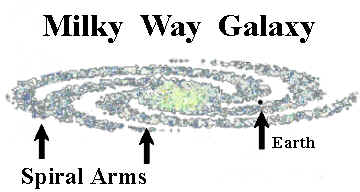
Our solar system is isolated safely between two
spiral arms of the Milky Way.(2) Inside the spiral arms, the star
densities are high enough to disrupt the orbits of planets like
Earth. Super giant stars residing inside the spiral arms
would expose Earth-like planets to radiation intense enough to
damage the planet’s atmospheric layers. The spiral arms are
loaded with gas and dust, which would block our view of
everything. But Earth’s position between the spiral arms
permits us to see other parts of our galaxy and several hundred
billion other galaxies in the universe. Earth sits safely on a
“window seat” that provides a clear view of the universe.
The Sun’s orbital position protects planet
Earth. Our Sun deviates little from its circular orbit around
the center of the Milky Way or from the plane of our galaxy’s
disk.(3) The other stars in our galaxy exhibit large deviations
from their orbital paths in up and down, back and forth, and side
to side random motions. The Sun’s slight orbital deviations of
just 13.4 kilometers per second keep our solar system from getting
too close to the spiral arms(4-5) and protect us from the deadly
radiation from our galaxy’s nucleus and cataclysmic deaths of
nearby stars. Our Sun appears to be an average star. However, to
be capable of having a planet suited to life as we know it,
scientists currently believe that the sun could be no more than
17% smaller or 10% larger.
Earth occupies a uniquely favored orbital
and planetary position. Earth’s planetary orbit is stable,
not disrupted by giant neighboring planets. If Earth were only a
half of a percent closer to the sun, we would experience a
run-away greenhouse effect. If as little as four percent closer to
the Sun, oceans never would have condensed and Earth’s climate
would have moved toward the inhospitable hothouse of Venus. If it
were only one percent farther from the Sun, Earth would become a
frozen ice planet like Mars and the outer planets, and atmospheric
greenhouse gases would become denser. Lungs could not function
under higher air pressures than those found at Earth’s
surface.(6) Earth is just the right distance from the Sun for
complex life and ensures that water remains liquid near the
surface, not vaporizing or freezing into ice—yet far enough away
to avoid tidal lock.
The Moon affects the survival of life on
Earth in three ways: Lunar tides, stabilizing the tilt of
Earth’s axis, and slowing down Earth’s rate of rotation.(7)
The Moon’s gravitational pull on Earth regulates ocean tides,
causing the sea waters to be cleansed and their nutrients
replenished.
The size and distance of the moon are just
right to stabilize Earth’s axis tilt at an angle of 23.5 degrees
and keeps the axis from wandering between the gravitational pulls
of the Sun and Jupiter.(8) Earth’s tilt angle is a critical
factor in maintaining mild climates and regulating the amount of
sunlight on the polar and equatorial regions. The planet Mercury,
whose axis angle is nearly perpendicular and who is the closest
planet to the Sun, has an extremely hot surface at the horizon and
extremely frozen surfaces at the poles. In contrast, the planet
Uranus has a 90-degree tilt with one pole exposed to the sunlight
for half a year, while the other pole remains in darkness.
The Moon is nearly a third the size of Earth.
All the other planets in the solar system have moons which are
trivial in weight compared to their mother planet. Not so for the
Earth. Our Earth-Moon system has very strongly influenced the
magnetic field of the Earth making it one hundred times larger
than it should be. This magnetism wraps the Earth in an invisible
shield that deflects many of the life-threatening particles
streaming from the Sun.
Jupiter shields Earth’s life. Jupiter
is ten times the size of Earth and 318 times more massive. Jupiter
has maintained a stable orbit around the Sun, balancing
gravitationally with the other planets. If Jupiter’s orbit were
not stable, gravitational disturbances would spin the planets out
of the solar system, escaping the gravitational hold of the Sun. A
life-bearing planet ejected into space would have no heat source
for warmth and no sunlight energy for photosynthesis.
If Jupiter were farther from Earth or less
massive than it is, Earth would be so blasted by asteroid and
comet collisions that life could not survive. Like a sentinel,
Jupiter purges stray bodies from our solar system. If Jupiter were
any closer to Earth or more massive than it is, Jupiter’s
gravity would pull Earth outside the zone of habitability and
stability.
The Remarkable Planet Earth. Earth’s
atmosphere is the right temperature, composition and pressure for
plant and animal life. The atmosphere has the right amount of
oxygen for photosynthesis, and just enough carbon dioxide and
other gases to preserve life.
Oxygen is the most abundant element in the
whole Earth (45% by weight and 85% by volume). But in the
atmosphere, it is a highly reactive gas that would exist only at
trace levels in the atmosphere of a terrestrial planet devoid of
life.(9)
Earth’s three ozone layers are perfectly
balanced. In the mesosphere (outer layer), the right amount of
ozone is needed to regulate life-essential chemical reactions and
chemical circulation. In the stratosphere (middle layer), too
little ozone would allow too much ultraviolet radiation to get
through to Earth’s surface, resulting in the death of many plant
and animal specie. Too much ozone would diminish the amount of UV
radiation reaching Earth’s surface, disturbing nutrient
production for plants and vitamin production for animals. In the
troposphere (nearest layer), a minimum ozone level is needed to
cleanse the atmosphere of natural pollutants. Too much ozone in
the troposphere would disrupt animal respiration.(10)
Conclusion: The miraculous parameters
for life on earth are fine-tuned into the laws that govern not
only our solar system, but also the universe. Not long ago
astrophysicist Carl Sagan estimated there were millions of planets
in our galaxy capable of sustaining life. But the 188 parameters
for life on Earth renders Sagan’s estimates sheer speculation.
Thus, Professor Ben Zuckerman, an evolutionist at UCLA, countered
that Earth is unique in our entire galaxy.(11)
Peter Ward, Professor of Geological Sciences at
University of Washington, and Donald Brownlee, Professor of
Astronomy at University of Washington and chief scientist of
NASA’s Stardust mission, in their highly acclaimed book Rare
Earth have concluded that animal life on Earth is rare in the
universe. “Almost all environments in the universe are terrible
for life. It’s only Garden of Eden places like Earth where it
can exist.”(12) In fact, Earth might well be the only place
animal life does exist.
In 1974, Brandon Carter, the British
mathematician, coined the term “anthropic principle.” The
anthropic principle says that the universe appears “designed”
for the sake of human life. All cosmology is pointing in this
direction. (13)
|
|
|
The Seven Days of Creation -
How Long Are They?
Chapter Four
The amazing drama of creation unfolds in the
first chapter of Genesis. Inevitably, the mind focuses on the
miraculous works of God during the six progressive days of
creation. Then on the seventh day God rests. How long is each day?
The Hebrew word yom here translated “day” has become a
point of controversy. In Scripture yom is used to denote
both a 24-hour day as well as a longer period of time.
For example, Israel’s forty years in
the wilderness is called “the day [yom] of temptation in
the wilderness. . .forty years long was I grieved with this
generation” (Psalm 95:8-10).
The Apostle Peter said, “But, beloved, be not
ignorant of this one thing, that one day is with the Lord as a thousand
years, and a thousand years as one day” (2 Peter 3:8).
Evolutionists propose fabulous lengths of time
for the evolution of fowl, fish and man. On the other hand, does
the Bible necessarily evidence each creative day as a 24-hour
solar day?
A Historic Overview
Insisting that the “24-hour day,” “the
young earth” and the “young universe” concept is the badge
of Fundamentalists and Evangelicals actually signals a marked
departure from the Fundamentalism of the early 1900s. First
published in 1909, the Scofield Reference Bible remains a standard
work among Fundamentalists and Evangelicals today.
Referring to “the heaven and earth” in
Genesis 1:1, this edition of Scofield commented, “The first
creative act refers to the dateless past, and gives scope for all
the geologic ages.”(1) Here the reference to “ages” is
significant. After noting that the word “day” used in
Scripture to denote either a 24-hour period of time or a longer
period of time, Scofield observed:
The use of “evening” and “morning”
may be held to limit “day” to the solar day; but the
frequent parabolic use of natural phenomena may warrant the
conclusion that each creative “day” was a period of time
marked off by a beginning and ending.(2)
The noted Evangelical scholar, Bernard Ramm,
documented this departure in the 1930s and 1940s from the original
Fundamentalist position of “epoch days of creation” along with
the “old earth and old universe” concepts. He observed that
some Fundamentalist periodicals began to feature articles by
George McCready Price, a Seventh Day Adventist, on his theories of
flood geology.(3)
By 1961 a rash of books began to be published
attacking evolution. Finally, the Christian community was
answering evolutionists with some counter-arguments on a logical,
scientific level! However, in a zeal to uphold the Biblical view
of creation, Fundamentalists embraced Price’s flood geology as a
basis for the young-universe, young-earth, 24-hour-creative-day
posture.
Without going into a complete critique of flood
geology, such a study does not automatically prove a young
universe or 24-hour creative days. This consolidated view led to
the formation of Creation Research Society in 1963. Its Board of
Directors included Fundamentalist/ Creation Advocate luminaries
like Henry M. Morris and W. E. Lammert along with Frank L. Marsh,
longtime Seventh Day Adventist advocate of the triad belief of a
young universe, a young earth and 24-hour creative days.(4)
By 1980 most U.S. Fundamentalist and
Evangelical churches forgot their roots of understanding Genesis
One as reflected in the Scofield
Reference Bible (which still stands prominently on their
reference shelves). Instead, they embraced the young-universe,
young-earth, 24-hour-creative-day combination championed by the
Seventh Day Adventists since the 1920s. (This reference to a
departure from fundamentalism to the Seventh Day Adventist concept
is in no way to downgrade the credibility of Seventh Day
Adventists as Christians. However, Adventists hardly represent
"historic fundamentalism.")
A growing number of Evangelicals, however, are
taking a dimmer view of this Adventist linkage as reflected in a
paper presented by Ronald L. Numbers at the Evangelical Engagement
with Science, a conference held at Wheaton College, March 30
through April 1, 1995. Numbers, a former Seventh Day Adventist and
the William Coleman Professor of the History of Science and
Medicine at the University of Wisconsin, observed:
. . . their [Adventists’] marginal views,
inspired by the visions of an Adventism prophetess, now defined
the very essence of creationism.(5) [Many of the teachings of
the Adventist originated in the vision of Mrs. Ellen G. White.]
The current popular 24-hour creative day is in
reality a fairly recent vintage. Even Henry M. Morris, its chief
exponent, spoke of the epoch days of creation as a “venerable”
concept. Indeed, the earliest known Christian writings on the time
frame of creation date back to the so-called early church fathers
of the second century. Justin Martyr (A.D. 100-166) and Irenaeus
(A.D. 130-200) believed the creation days were epoch days.(6)
But before this time and more importantly,
Jesus Christ and the Apostle Paul taught the creation epoch days
(as will be discussed later).
Objection Overruled
Since the phrase, “and the evening and the
morning,” is used to denote the conclusion of the first six
creation days, some say this is a perfect description of literal
24-hour days. Not so. The phrase, “evening and morning,” like yom,
can denote a longer period of time. The “2300 days” vision of
Daniel 8 is a case in point. Daniel was given a vision that
includes a period of 2300 days. Then Daniel was told by Gabriel
(Daniel 8:26), “. . .and the vision of the evening and the
morning which was told is true.”
Unfortunately some translations render the
text, “evenings and mornings” of vs. 26 in the plural. This is
not accurate. The Hebrew manuscript in Daniel 8:26 reads exactly
as the singular case in Genesis One, “the evening and the
morning,” as noted in standard evangelical works.(7)
The Scriptures elsewhere use the same Hebrew
word “evening” in relation to a day (yom) of long
duration. Zechariah speaks of “the day of the Lord” and the
following verses describe the events of that day (Zechariah 14:1).
The following vss. 6,7, state that day (yom) is “not
clear or dark,” but “at evening time it shall be light.”
Evidently, this is referring to the Millennial Day (1,000 years)
of Christ’s Kingdom. By the end of that 1,000-year day, full
knowledge of the Lord (“light”) would prevail. But some apply
“evening” to the “great tribulation.” Either way, this day
is a period of time, but not a 24-hour day's evening, though the
“day” has an “evening.” Therefore, the fact that the
creation days have an “evening” does not prove that they are
necessarily 24-hour days.
The “Creative Day”— How Long?
Internal evidence in Chapters One and Two of
Genesis provides conclusive proof that the seven creative days are
not each 24 hours. The Hebrew word yom, used exclusively in
Genesis to denote “day,” should be understood to signify an
epoch of time.
Proof #1
After Genesis 1:1 - 2:3 describes the creation
of the heavens and the earth, including the account of the seven
creative days (yom), the very next verse (Genesis 2:4)
summarizes the entire work of the preceding verses:
“These are the generations
[Hebrew,
“history”] of the heavens and the earth when they were
created in the day [yom] that the Lord made the heavens and
earth.”
The whole period of creation is designated in
this verse as “the day”! Therefore, “day” must be defined
contextually and cannot at all be assumed to be a period of
twenty-four hours.
Proof #2
In Genesis 1:14-19 not until the fourth day is
the Sun and Moon “made” (Hebrew, “appointed”) to rule the
day and the night. The Sun would “rule” the Earth because time
on Earth could be calculated by one rotation around the Sun.
Before the fourth day, Earth’s atmosphere was too dense to
permit the penetration of sunlight. So if the 24-hour day did not
come into existence until after the third creative day, it
is logical to conclude that none of the preceding creation days
were twenty-four hours long.
Proof #3
God created the fish, sea life and fowls of the
air on the fifth day (Genesis 1:20-22). In addition, vs. 21
reveals that on that same fifth day the living creatures of the
waters “brought forth abundantly after their kind and every
winged fowl after his kind.” God did not create myriads of
each Genesis kind of water life in order to fill the sea nor
myriads of fowl to fill the earth. Rather, on the fifth day God
created an appropriate number of Genesis kind species and then
commanded that through the natural process of reproduction the
waters would teem with sea life and that the fowls would multiply
throughout the earth.
Is it possible for fish in one 24-hour day to
reproduce successive generations in order to fill the sea? Of
necessity the fifth day was a period of time. The narration
further emphasizes how the commission to “be fruitful and
multiply” was all part of what was accomplished on the fifth day
(vss. 22, 23).
Proof #4
The time required for the sixth creative day is
critical to consider. First, God created all the land animals.
Then towards the end of the sixth day, the crowning feature of his
creative work was Adam and Eve. While the first chapter of Genesis
only briefly narrates the creation of Adam and Eve, the second
chapter (2:7-9, 15-23) elaborates on the events that occurred
between Adam’s creation and Eve’s.
First, God planted a garden in Eden, then Adam
after receiving instructions from God worked in the caring of the
garden. There was extensive communication pertaining to things
Adam could and could not do. Adam was then instructed to name all
of the birds and all of the living creatures. With this extensive
responsibility in caring for all the plants and naming all the
animals, Adam had time to experience loneliness in his heart
because “there was not found an help meet for him.”
All these events took place in the latter part
of the sixth creative day. How long could this activity have
reasonably taken? Just a few hours or days, weeks or months? Of
necessity, the events of the sixth day required more than
twenty-four hours.
Proof #5
How long is the seventh day? God finished His
creative work at the beginning of the seventh day and rested
(Genesis 2:1-3). But the Genesis account is clear that the seventh
day did not end. In the first six creation days, the Lord
conclusively ended each day with the phrase, “the evening and
the morning was the day.”
However, the seventh day description in Genesis
2:2-3 does not conclude with the phrase, “the evening and the
morning were the seventh day.” Nor does this account indicate in
any other way that the seventh day ended. On the contrary, Hebrews
3:7-4:8 contains an elaborate study to demonstrate that the
seventh creative day has not yet ended.
The Apostle Paul first quoted Psalms (95:7-11)
to prove that Israel failed to enter into God’s seventh day of
rest during the time of Moses, Joshua and David: “Today if you
hear his voice, do not harden your hearts as when they provoked
me, as in the day of trial in the wilderness. . .as I swore in my
wrath, they shall not enter my rest” (Hebrews 3:7,8,11,
NAS).
Paul’s logic followed in Hebrews 4:4,5,
“For He [God] spake in a certain place of the seventh day
[Genesis 2:2] and God rested on the seventh day from all his
works; and again in this place [Psalms 95:11] they shall
not enter my rest.” Verses 7 and 8 spell out that this
failure occurred under Moses, Joshua and David. In other words,
Israel failed to enter into God’s seventh day of rest.
Therefore, the seventh day on which God rested extended to
Moses’ time and beyond that to Joshua’s time and even beyond
that to David’s time:
Again, he [God] limiteth [Greek, “marks out
the limits of”] a certain day [the seventh day] saying in
David [Psalms 95:7,8], To day, after so long a time
[since Moses’ time]; as it is said, To day if ye will hear
his voice, harden not your hearts. For if Joshua had given
them rest, then he [God] would not afterward have spoken
of another day (Hebrews 4:7,8 NAS).
Here Paul reasoned that by God’s own
definition, the seventh day on which God rested extended to the
“to day” of David’s time.
Now back to Paul’s logic in Hebrews 3:6-13:
Since Israel failed, Christians are admonished, “But exhort one
another daily, while it is called To day; lest we fail to
enter into God’s rest [of the seventh day].” The whole
Christian Age is also included in the “To day” time frame of
the seventh day of God's rest!
And that is precisely why Paul said, “There
remains therefore a Sabbath rest for the people of God. For
the one who has entered His [God’s] rest has himself also rested
from his works, as God did from His” (Hebrews 4:9,10 NAS). The
word “Sabbath” is definitely in the Greek text and refers to
the seventh creative day in which God rested.
By faith Christians can now enter into this
seventh day of Sabbath rest with God. Just as God rested from His
works of creation (although God’s work of governing the universe
continued), Christians cease from their own works and rest in the
finished work of Christ.
Therefore, the seventh day is an epoch
extending from just after the creation of man and includes the
time of the Christian Age. If the seventh day is an epoch
extending thousands (not millions) of years, the other creation
days must be epochs as well.
Just how long is the epoch-long seventh day?
God’s Rest
When our first parents disobeyed and were cast
out of their perfect Edenic paradise into the “thorns and
thistles” of the unfinished Earth (Genesis 3:17-19), God ceased
from His works of creation and rested. But God’s works of
creation were not completed. He was not finished with man. He was
not finished with the Earth.
The Scriptures teach that God did not create
the Earth in vain, “God himself that formed the Earth. . .he
created it not in vain, he formed it to be inhabited” (Isaiah
45:18). The Earth was created to be filled with people praising
their God (Psalms 98:4-6). They would enjoy perfect health (Isaiah
35:5,6). The whole Earth—their Edenic home—was to “blossom
as a rose” (Isaiah 35:1).
Man was perfect and rejoicing in his beautiful
home in Eden, but everything changed when sin entered. So when
would these completed works of creation be accomplished? When
would the earth be finished and perfect? When would man be
finished, perfect?
As might be anticipated, Christ would
accomplish this work at his second advent. All the holy prophets
pointed toward this time. It would be a time of restoration to the
perfection of man in the Garden of Eden and all the wonderful
potential he possessed at that time. Thus Apostle Peter said,
“He shall send Jesus Christ. . .whom the heaven must receive
until the times of restitution [restoration] of all things which
God hath spoken by the mouth of all his holy prophets since the
world began” (Acts 3:20,21).
God’s rest on the seventh creative day or age
was a rest of confidence in the finished work of Christ. God has
complete confidence in the ability of Christ to restore to the
willing descendants of Adam everything that was lost when Adam
disobeyed in Eden.
This is why Jesus identified himself as the
“Lord of the Sabbath” (Mark 2:28), not the seventh day of our
week, but the seventh day of God’s week of creation. As Lord of
God’s seventh creative day, Christ’s responsibility is to
perform, “the works which the Father has given me to finish”
(John 5:36).
Was the entrance of sin an unplanned
miscalculation on God’s part? Not at all. Before God even
created Adam, God knew that Adam would sin and plunge his
descendants into sin and death. Redemption by the blood of Jesus
was “foreordained before the foundation of the world” (I Peter
1:19,20). When Adam sinned, God ceased His creative works resting
in full confidence in Christ’s ability to first redeem humankind
(I Corinthians 15:22) and then to offer to all the restoration of
all things lost in Adam (Luke 19:10).
So if Christ died almost 2,000 years ago, why
are man and his earthly home still in sin and not restored and
perfect? The time between the redemption and the time of
restoration is devoted to the call and preparation of a “little
flock” of faithful followers of Christ who will share with
Christ in his 1,000-year Kingdom restoration project (Acts
15:14-17; Revelation 20:6; 22:17). Now is not the time for the
conversion and restoration of the world of mankind (Mark 4:11,12).
One of the most important works which God has
given Christ to complete is the raising of the dead:
For as the Father hath life in himself; so
hath he given to the Son to have life in himself; and hath given
him authority to execute judgment also, because he is the Son of
man. Marvel not at this: for the hour is coming, in the which
all that are in the graves shall hear his voice and come forth;
and they that have done good [the little flock] to a
resurrection of life [to live and reign with him 1,000 years];
and they that have done evil [all the remaining of the race] to
a resurrection of judgment [krisis, Greek for
“trial”] (John 5:26-29).
By the end of the 1,000 years, all will have
been given a full and fair opportunity to attain perfect life in a
worldwide Edenic paradise. Those who fail under these ideal
conditions will be destroyed (Jeremiah 31:29,30; Isaiah 35; Acts
3:19-23). Then the seventh creation day will reach its climactic
conclusion: “There shall be no more death, neither sorrow, nor
crying, neither shall there be any more pain: for the former
things are passed away” (Revelation 21:4).
From Bible chronology it can be determined that
the seventh creative day is 7,000 years in duration and
culminating with the 1,000 years of restoration.
Although some might prefer the assumption that
each creative day is of varying lengths covering aeons of time, it
seems logical to conclude that the creation week consists of 7
days that are all uniform in length. There are independent
scriptural lines of reasoning that indicate the creation week
would total 49,000 years—ample time for God’s miraculous yet
complex creation work. Whether or not all agree with this estimate
of the total length of the creative week, it is Scripturally
certain that each creative “day” was longer than twenty-four
hours.
What about the Earth itself? Since the earth
was in existence but “without form and void,” before the
creation week began—the age of the Earth, or for that matter,
the universe, would not be included in the creative week.
Therefore, the Earth is doubtless much older! Without attempting
to compromise with evolutionists’ wild speculations of the aeons
of time required for the “evolution of man,” the Bible
presents a reasonable length of time for a progressive creative
week climaxed by the creation of man. Not a week of one-hundred
sixty-eight hours! The Genesis account is sublimely reasonable.
Age of the Universe
Observations of the universe’s most distant
reaches by the Hubble space telescope suggest that the age of the
universe is over 13 billion years. Independently, radio telescope
measurements are consistent with a universe age near 14.6 billion
years.
A third line of independent
observations—efforts to explain the order in the subatomic world
and the observed ratio of matter to light in the universe—have
led other scientists to conclude that the age of the universe is
14.6 billion years. Whatever one’s evaluation of estimates, they
are beyond the scope of the Genesis record.
|
|
|
Darwinian Evolution
—
Fact or Theory?
Chapter Five
The exponents of Darwin’s evolution have long
declared this theory a scientific fact. But by its own rules,
science requires empirical proof—that is, observation. After
over 140 years of research, what empirical proof have Darwinists
compiled? The following discussion applies the litmus test of
science itself against the various speculations evolutionists have
pursued for explaining the evolutionary process.
Natural Selection Vs. Artificial Selection
“Natural selection” proposes species are
constantly replacing species in a process called “descent with
modification.” Natural selection is the mechanism responsible
for all the varieties of plants and animals. The guiding force
—
“survival of the fittest” —
is blindly deciding which species
survive.
What Darwin identified as “variation” is
today explained as achieved by mutations. “Mutations are
randomly occurring changes which are nearly always harmful when
they produce effects in the organism large enough to be visible,
but which may occasionally slightly improve the organism’s
ability to survive and reproduce.”(1) But did Darwin explain his
theory of evolution by natural selection? The noted Darwinist,
Douglas Futuyma, explained:
When Darwin wrote
The
Origin of Species, he could offer no good cases of
natural selection because no one had looked for them. He drew
instead an analogy with the artificial selection that animal and
plant breeders use to improve domesticated varieties of animals
and plants. By breeding only from the woolliest sheep, the most
fertile chickens, and so on, breeders have been spectacularly
successful in altering almost every imaginable characteristic of
our domesticated animals and plants to the point where most of
them differ from their wild ancestors far more than related
species differ from them. (2)
Do all evolutionists cite artificial selection
as a proof of what “natural selection” is supposed to achieve?
The eminent French zoologist Pierre Grasse, an evolutionist but a
strong anti-Darwinist, concluded that the results of artificial
selection provide powerful testimony against Darwin’s theory:
In spite of the intense pressure generated by
artificial selection (eliminating any parent not answering the
criteria of choice) over whole millennia, no new species are
born. A comparative study of sera, hemoglobin, blood proteins,
interfertility, etc., proves that the strains remain within the
same specific definition. This is not a matter of opinion or
subjective classification, but a measurable reality. The fact is
that selection gives tangible form to and gathers together all
the varieties a genome is capable of producing, but does not
constitute an innovative evolutionary process. (3)
In other words, the reason that dogs do not
become as big as elephants, much less change into elephants, is
not that we have not been breeding them long enough. Dogs do not
have the genetic capacity for that degree of change, and they stop
getting bigger when the genetic limit is reached. Cries of “not
enough time” to produce new species should be muted by
exhaustive research with the fruit fly. Since the life span of the
fruit fly is so short, it represents mutation observation over
thousands of generations in a short period of time. The fact that
scientists have been able to breed fruit flies into every possible
genotype only proves that fruit flies can be caused to change
through artificial selection, but not natural selection.
If artificial selection proves anything, it
proves that an intelligent manipulation of genetics is sometimes
able to produce a woollier sheep, a better tomato, and a different
looking fruit fly. In any case, the end result of all these genetic
experiments is that a fruit fly is still a fruit fly—not a new
species. This does not make a case for beneficial mutations being
the engine behind natural selection.
Natural Selection and Tautology
Tautology is a way of saying the same thing
twice. The noted law professor turned prosecutor of Darwinism,
Phillip E. Johnson, zeroed in on the tautology fallacy of
Darwinism as reflected in the following:
The famous philosopher of science Karl Popper
at one time wrote that Darwinism is not really a scientific
theory because natural selection is an all-purpose explanation
which can account for anything, and which, therefore, explains
nothing. Popper backed away from this position after he was
besieged by indignant Darwinist protests, but he had plenty of
justification for taking it. As he wrote in his own defense,
“some of the greatest contemporary Darwinists themselves
formulate the theory in such a way that it amounts to the
tautology that those organisms that leave most offspring leave
most offspring,” citing Fisher, Haldane, Simpson, “and
others.” (4)
One of the “others” referred to was
Waddington, whose explanation Johnson said should be preserved for
posterity:
Darwin’s major contribution was, of course,
the suggestion that evolution can be explained by the natural
selection of random variations. Natural selection, which was at
first considered as though it were a hypothesis that was in need
of experimental or observational confirmation, turns out on
closer inspection to be a tautology, a statement of an
inevitable but previously unrecognized relation. It states that
the fittest individuals in a population (defined as those which
leave most offspring) will leave the most offspring. This fact
in no way reduces the magnitude of Darwin’s achievement; only
after it was clearly formulated, could biologists realize the
enormous power of the principle as a weapon of explanation. (5)
Johnson observed that this statement of
Waddington’s was not just an offhand statement:
That was not an offhand statement, but a
considered judgment published in a paper presented at the great
convocation at the University of Chicago in 1959 celebrating the
hundredth anniversary of the publication of The Origin of
Species. Apparently, none of the distinguished authorities
present told Waddington that a tautology does not explain
anything. When I want to know how a fish can become a man, I am
not enlightened by being told that the organisms that leave the
most offspring are the ones that leave the most offspring.
The important point is that the Darwinists
have been tempted continually by the thought that their theory
could be given the status of an a priori truth, or a logical
inevitability; so that it could be known to be true without the
need of empirical confirmation. Their susceptibility to this
temptation is understandable. When the theory is stated as a
hypothesis requiring empirical confirmation, the supporting
evidence is not impressive. (6)
Thus, many of the scientific community hold
natural selection as a philosophical necessity—some scientists
demand a naturalistic explanation for everything. Since God or any
other “vital force” that drives evolution is excluded by the
National Academy of Sciences, evolutionists have to make do with
what is left when the unacceptable has been excluded. Natural
selection is the best of the remaining alternatives—probably the
only alternative.
There are many other anomalies inherent in the
idea of natural selection. Why haven’t many of the
“lower-order” creatures with us today evolved into something
on the same level as humans? Why do some animals risk their own
safety to warn others of an approaching predator? Why is a female
pea-hen attracted to a male peacock with “life-threatening”
decorations? Explanations for these inconsistencies make it
difficult to conceive of a way to test the claims empirically.
Mutations and Saltations
One of the concepts related to mutations that
evolutionists try to avoid is the evidence of “saltations,”
that is, sudden leaps by which a new type of organism
appears in a single generation. Darwin himself thought that
saltations were nothing less than miracles. T. H. Huxley warned
Darwin of dismissing saltation too quickly. Huxley’s reason for
this caution was the lack of fossil record supporting the gradualism
Darwin proposed.
Problems are created when evolutionists discard
the concept of saltation. Why would wings or eyes continue to
develop in a creature with no apparent functionality—unless the
system evolved at once? The first step towards a new
function—such as vision or ability to fly—would not
necessarily provide any advantage unless the other parts required
for the function appeared simultaneously.
A noted professor, Richard Goldschmidt,
challenged the Darwinian concept of micro-mutations, holding that
this concept “could account for no more than variations within
the species boundary.”(7) He admitted that macro-mutation would
usually produce harmful development, but thought it possible that
occasionally a “hopeful monster” would emerge and develop a
new species. But with what mate is the logical question.
The micro-macro question has been argued by two
contemporary evolutionist giants, Dawkins and Gould. Richard
Dawkins, the Dean of British Scientists, defended Darwin’s
gradualism— micro-mutation. Stephen Jay Gould, the eminent
paleontologist of Harvard, attempted to harmonize saltations with
a form of macro-mutation.
The bottom line is that there is no way to
prove if either such mutations ever occurred. If after
“massive” research, scientists were able to alter the genetic
code of a fish to produce an amphibian, would that prove anything?
No, this artificial manipulation proves nothing about random
changes. This type of experimentation would only prove that these
changes could be planned and executed by an intelligent
scientist. But whether God as the Intelligent Creator would
employ this method to achieve wonderful variety is another
question.
Demonstrating that mutations can be beneficial
poses a significant problem to the evolutionist. The mathematical
calculations required to predict whether micro- or macro-mutations
would be advantageous are staggering. Mathematician D.S. Ulam
concluded that the amount of mutations needed to create an eye
made it impossible. Evolutionists retorted by stating that the eye
had evolved. Ernst Mayr responded, “Somehow or other by
adjusting these [Ulam’s] figures, we will come out all right. We
are comforted by the fact that evolution has occurred.”(8) This
attitude in the scientific community of evolutionists reflects an
incredible position. Notwithstanding the complete lack of
empirical evidence, evolution is considered an a priori fact and
law.
Lack of Fossil Evidence
The lack of fossil evidence is perhaps the
greatest challenge to Darwinism. Darwin himself bemoaned the fact
that we did not “everywhere see innumerable transitional
forms.” He even admitted that the state of fossil evidence was
“the most obvious and gravest objection which can be urged
against my theory.”(9)
After 140 years of evolutionists desperately
looking for missing links, Gould offered “punctuated
equilibrium” to deal with the embarrassing fact: “The fossil
record today on the whole looks very much as it did in
1859.”(10) Gould summarized his concept as follows:
The history of most fossil species includes
two features particularly inconsistent with gradualism:
1. Stasis. Most species exhibit no
directional change during their tenure on earth. They appear in
the fossil record looking pretty much the same as they
disappear; morphological change is usually limited and
directionless.
2. Sudden appearance. In any local area, a
species does not arise gradually by the steady transformation of
its ancestors; it appears all at once and “fully formed.”
(11)
The essential point of Gould’s “punctuated
equilibrium” is that the new species appear in peripheral
groups, whereas the fossil record is available basically from the
larger, main populations—that is why new species seem to appear
suddenly:
Speciation (the formation of new species)
occurs rapidly, and in small groups which are isolated on the
periphery of the geographical area occupied by the ancestral
species.... Because fossils are mostly derived from large,
central populations, a new species would appear suddenly in the
fossil record following its migration into the center of the
ancestral range. (12)
In this small isolated population, Gould
explained, selective pressures might cause favorable variations to
spread more rapidly. In this manner, a new species would arise in
the peripheral area without leaving fossil evidence. “Punctuated
equilibrium” is a very interesting speculation. But how much
more plausible to explain by the Genesis account what is already
empirically self-evident from the fossil record! Well defined
species were created in a logical sequence of complexity, each
allowing genetically for variations within its own “kind.”
The single greatest challenge which the fossil
record poses for Darwinism is the “Cambrian Explosion” which
they date around 600 million years ago. Nearly all the animal
phyla appear in the rocks of this Cambrian period without a trace
of the evolutionary ancestors that Darwinism requires. As Richard
Dawkins put it, “It is as though they were just planted there,
without evolutionary history.”
In fact, Darwin himself found no evidence of
the existence of pre-Cambrian life and conceded in
The
Origin of Species, “The case at present must remain
inexplicable, and may be truly urged as a valid argument against
the view here entertained.” If his theory were true, Darwin
wrote, the pre-Cambrian world must have “swarmed with living
creatures.” But, as Dawkins observed, after over a hundred years
of searching the fossil record, the pre-Cambrian world did not
swarm with living creatures.
Missing links haunt evolutionists throughout
the fossil record. Though there is evidence of micro-mutation
within the Genesis kind, after 140 years of gene manipulation in
the laboratory and intensive investigation of the fossil record,
there is no evidence of micro- or macro-mutation bridging from one
Genesis kind to another. Darwinians and neo-Darwinians are
frantically advancing multiple theories to minimize this lack of
empirical fossil evidence.
Although they present a united front that
evolution is a fact, they are in vast disarray when it comes to
the how of proving that evolution is even a workable
possibility. In the face-off between the two Darwinian giants,
Dawkins and Gould, each claimed that his own mutation
theory—voiding out any other—is the only way to explain
missing links. The truth is Dawkins’ and Gould’s evaluations
of each other’s mutation theories cancel out each other!
Neither view can provide empirical evidence of
bridging gaps in the fossil record. But the sudden appearances of
new species in the fossil record—the “Cambrian
Explosion”—is consistent with the Creation model. The fossil
record is still testimony against Darwinian evolution.
Homology in Embryology
Some evolutionists attempt to establish their
theory by pointing out certain similarities embryos share that
belong to different species. Since evolution is considered a fact,
biological relationships are assumed to signify evolutionary
relationships. Homology and embryology have been put forward
as proof of the “fact of evolution.”
In 1866 Ernst Haeckel formulated what came to
be know as the “Biogenetic Law” or “Haeckel’s Law,”
which simply stated means, an embryo will recapitulate (summarize)
the evolutionary stages of a life form during the embryo’s
development. To Darwin, Haeckel’s Law established the fact of
evolution. Therefore, Darwin based his research in the fields of
natural selection, the fossil record, the vertebrate sequence,
pre-biological evolution, etc., on the a priori assumption
evolution was a fact because of this “Law.” This a priori
“logic” has been the basic flaw of evolutionists ever since.
For centuries philosophers have noted the
relationships between different animals and always attributed
these similarities—not as inheritance from common
ancestors—but to a sort of blueprint called the “Archetype,”
which existed only in some metaphysical realm such as the mind of
the Divine Creator.
Darwin’s theory of “descent with
modification” offered a naturalistic alternative to the idea of
the Archetype. Darwin described his theory, “The characters
which naturalists consider as showing true affinity between any
two or more species, are those which have inherited from a common
parent, and insofar, all true classification is
genealogical.”(13)
Neither laboratory science nor the fossil
record has been able to provide empirical evidence for the theory
of “descent with modification.” However, the “fact of
evolution” seems to stand unscathed regardless of the lack in
the validity of its records and proposed mechanisms. Stephen Jay
Gould made a false analogy regarding the “fact of evolution”:
Facts are the world’s data. Theories are
structures of ideas that explain and interpret facts. Facts do
not go away while scientists debate rival theories for
explaining them. Einstein’s theory of gravitation replaced
Newton’s, but apples did not suspend themselves in mid-air
pending the outcome. And human beings evolved from ape-like
ancestors whether they did so by Darwin’s proposed mechanism
or by some other, yet to be identified. (14)
Is this comparison fair? Johnson ably refuted
Gould’s reasoning:
The analogy is spurious. We observe directly
that apples fall when dropped, but we do not observe a common
ancestor for modern apes and humans. What we do observe is that
apes and humans are physically and biochemically more like each
other than they are like rabbits, snakes, or trees. The ape-like
common ancestor is a hypothesis in a theory, which purports to
explain how these greater and lesser similarities came about.
The theory is plausible, especially to a philosophical
materialist, but it may nonetheless be false. (15)
Without empirical evidence in the laboratory or
fossil records, Darwin and his loyal legion seized upon homology
in embryology to prove the “fact” of evolution. The argument
from embryology is based primarily upon the ideas of Haeckel’s
biogenetic law. In erudite descriptive form, this law means
“ontogeny recapitulates phylogeny.” Or, in other words, an
“individual” will summarize his evolutionary history by
passing through similar evolutionary stages during his
embryological development.
So it has been popularly believed that man has
a gill stage, a hair stage, tail stage, protozoan stage, worm
stage, etc. Embryo similarities are an evidence all are taught to
believe even in elementary biology courses. Surprising as it may
seem, however, this evidence has been rejected by practically all
competent biologists.
Notwithstanding his “fact-of-evolution”
posture, Gould had to disassociate himself from Haeckel’s
Law—the only law of science that seemed to give credence that
evolution was, indeed, a fact. Gould remarked:
. . .the New York public schools taught him
Haeckel’s doctrine, that ontogeny recapitulates phylogeny,
fifty years ago it had been abandoned by science. . .behind
closed doors many scientists will admit to thinking that
“there really is something to it after all.” (16)
Haeckel’s Law has been replaced by Von
Baer’s Law which “asserts that resemblances among embryos
reflect levels of biological classification, so that all
vertebrates, for example, look very similar in early development
but become increasingly dissimilar as they approach their adult
forms.” Unfortunately, the embryos do not start out similarly,
but only converge to a similar embryo in the middle of development
only to diverge again to develop into fish, birds and mammals.
Thus, while all vertebrates pass through an
embryonic stage in which there is a resemblance, actually they
develop to this stage very differently. When the egg is
fertilized, each Genesis kind follows its own plan of embryonic
development. Fish, amphibians, birds and mammals each follows
their own pattern. Only by ignoring these early stages of
development can Darwin’s theory harmonize with the facts of
embryology. Yet it was the early stages that were crucial to
Darwin’s claim.
The latter stages of embryo development are
also out of sync with Darwinian expectations. For instance, limb
development is an instructive example. The embryonic development
of limb bones reveals patterns of division, branching and
cartilage production which differ from Genesis kind to Genesis
kind without conforming to predictions based on the theory of
common descent.
The “fact of embryology” is that all
vertebrate embryos follow different patterns of development, then
midway through the process converge into similar appearances—and
again diverge until they finally through diverse processes develop
similar bone structure in their limbs. Can embryology be
harmonized with either a Creator’s “archetype” or Darwin’s
“descent with modification”? That embryology alone cannot be
used to prove either is fact. However, the scale tips more in
support of creation, as Johnson observed:
If embryology is our best guide to genealogy,
as Darwin thought, our guide seems to be telling us that
vertebrates have multiple origins and did not inherit their
similarities from a common ancestor. (17)
Vertebrate Sequence
Imposing vertebrate exhibits in museums show
neat progressive evolutionary sequences of vertebrate development
from the simple to the complex. The evolutionist smugly says,
“There you have it—proof positive that evolution is a fact!”
Marsh’s fossil pedigree of the horse displayed at Yale
University convinced Thomas H. Huxley himself of the
“irrefutable truth” of evolution. There it was—the evolution
of the horse beginning with Eohippus (the so-called “Dawn
Horse”) which was the size of a fox terrier, possessing several
toes with the display climaxing with Equus, the tall, majestic
modern-day horse.
Darwin had planned to make the trip to see
Marsh’s collection, but health did not permit. As P. I. Lull
lamented, “He died without having seen such a culminating proof
of his theory of evolution.”
But there is less than meets the eye on these
impressively neat simple-to-complex, small-to-large displays of
vertebrate sequences! This “less than meets the eye” was quite
evident in an interview with Gareth Nelson, of the American Museum
of Natural History. When asked about the question of vertebrate
sequence, Nelson said, “We’ve got to have some ancestors.
We’ll pick those. Why? Because we know they have to be there,
and these are the best candidates. That’s by and large the way
it has worked. I am not exaggerating.”(18)
Again, this is not empirical proof. It is the
same persistent flaw of the evolutionist—the a priori assumption.
If evolution is assumed as fact, then the vertebrate sequence has
to be rigged to prove evolution. The sequence from small
several-toed ancestors to large one-toed horses is nowhere to be
found in the fossil record. Furthermore, many contradictions to
this presumed order are conspicuous. For example, two modern-type
horses, Equus nevadensis and Equus occidentalis,
have been found in the same geological stratum as Eohippus. This
fossil record verifies modern-day-type horses were grazing side by
side with their so-called ancestor.
An evolutionist of note, G. G. Simpson,
asserted that the development of the horse is not by
“orthogenesis”—in a straight line. Simpson’s vertebrate
sequence of the horse is vastly different from Marsh’s at Yale.
(Simpson was from Harvard.) Simpson declared, “This is not a
sequence involving lower and higher zones, but evolution in a
single, changing zone.”(19) Regarding the gradual reduction from
several toes to a single toe or hoof, Simpson said that it is
“flatly fictitious.”(20)
Horses vary today from “Gumbo,” an 18-inch
tall American Miniature Yearling Stallion (which is even smaller
in Argentina)—to the seven-foot high 3,200-pound Clydesdales.
Another contradiction to the presumed order of evolving horses is
that some present-day Shire horses have more than one toe per
foot.(21) Similarly, antelopes vary from the 12-inch Suni to the
6-foot, 2,000-pound Eland.
Evolutionists take great satisfaction in
discussing evolution within the horse specie. But what type of
evolution is this? “Micro-evolution” at best—wonderful
variation within a Genesis kind—the horse “kind.” The
evolutionists’ forced extrapolation that the great diversity
within the horse kind proves Darwinism evolution is not valid. By
definition, Darwinism requires evolution from one Genesis kind to
another Genesis kind.
How can documentation of evolution of horses
into horses, moths into moths, minulus into minulus, fruit flies into
fruit flies, prove the evolution from amoeba to man? At every
stage of the evolutionary tree, there are question marks demanding
proof for common ancestry of all organism. (See diagram.)
Where Are the Transitions?
Fish to Amphibians. Some Darwinists
propose that the rhipidistians, an extinct order of fish, as a
possible “ancestral group.” The rhipidistians are thought to
have skeletal features similar to early amphibians which have
bones that look like they have the potential to evolve into legs.
Not so! said evolutionist Barbara J. Stahl in her comprehensive
textbook:
None of the known fish [sic] is thought to be
directly ancestral to the earliest land vertebrates. Most of
them lived after the first amphibians appeared, and those that
came before show no evidence of developing the stout limbs and
ribs that characterized the primitive tetrapods. (22)
The coelacanth, an ancient fish thought to be
extinct in the same class as rhipidistians, was caught in the
Indian Ocean. When dissected, its skeletal features and internal
organs showed no signs of being preadapted for a land environment.
There is still no evidence of any transition form of life between
the fish and the amphibian classifications.
Amphibians to Reptiles. Transitional
ancestors to the reptiles were required. Darwinists selected the
so-called stem reptile, Seymouria. Embarrassment was readily
imagined when this selected “ancestor” was dated by
evolutionary methods as existing 20 million years after
reptiles already appeared on the earth. Evolutionists do not
present a valid case for any possible link between amphibians and
reptiles.
Diagram of Three Genesis Kinds
Chart (23)*
*Note: The above chart seems
plausible.
Reptiles to Mammals. If reptiles,
indeed, evolved into mammals, transitional ancestors for mammals
would need to be established. Evolutionists chose the large order
of therapsida, a mammal-like reptile. As a recognized
expert in mammal-like reptiles, A. Hopson ventured a vertebrate
sequence of therapsids to bridge from different orders and
subgroups of reptiles ending his sequence with a mammal—the Morgamicodon.
The only problem was that the Morgamicodon was
substantially older than the therapsid that preceded
it!(24) This attempt hardly qualifies as an ancestry hypothesis.
In any case, more than one transitional life
form would be necessary to establish because of so much diversity
among mammals. As Johnson observes:
The mammal class includes such diverse groups
as whales, porpoises, seals, polar bears, bats, cattle, monkeys,
cats, pigs, and opossums. If mammals are a monophyletic group,
then the Darwinian model requires that every one of the groups
have descended from a single unidentified small land mammal.
Huge numbers of intermediate species in the direct line of
transition would have had to exist [for every diverse group of
mammals], but the fossil record fails to record them. (25)
Reptiles to birds. In 1998 two fossils
of feathered dinosaurs were discovered in China’s Liaoning
province. The fossils were acclaimed as the “missing link”
between reptiles and birds. However, the feathers found on the two
species, Caudipteryx and Protoarchaeopteryx, were
fully formed—a true “missing link” would reveal stages of
development between scales and feathers. The dinosaur fossils are
reportedly 120-145 million years old, however, the oldest known
bird fossil is the allegedly 150-million -year-old Archaeopteryx,
a dead end side branch of the ancient avian line of birds.(26)
Thus, the fossil sequence contradicts the conclusion that the bird
evolved from the dinosaur—the bird fossils are older than the
dinosaur fossils.
Apes to Humans. An anthropologist who
believes in the evolution of humans from apes would select
ancestors that would fit a neat sequence. Even if these sequences
are only constructed from a tooth or jawbone. The late Solly
Zuckerman (now Lord Zuckerman), one of Britain’s most
influential scientists and leading primate experts, was an ardent
evolutionist. Questioning the reliability of anthropology, he said
that anthropology “is so astonishing that it is legitimate to
ask whether much science is yet found in this field at all.”(27)
Concerning the evolutionary sequence attempts between ape and
humans, Zuckerman admitted, “depend. . .partly on guesswork, and
partly on some preconceived conception of the course of hominid
evolution.”(28)
If it is assumed in advance that ancestors of
humans must have existed, there are only a few ambiguous examples
of possible candidates for the transitional forms. These
inconclusive examples represent what 140 years of frenzied
research have produced. These sequences in the “evolutionary
tree” are but scrawny branches when reason would demand
numerous, even thick bushy transitional branches.
In addition, the resolute claims of Darwinian
evolution beg the question, Why does not the fossil record abound
with numerous species possessing partially formed organs, such as,
20 percent feather, 80 percent scale, 75 percent wing, 25 percent
leg, 60 percent foot, 40 percent fin, 12 percent flower or 88
percent spore? If evolution were a fact, then life today should
still abound with these transitional organisms. Because
evolutionists attempt to ignore this lack of empirical evidence in
the fossil record, evolution remains just a theory without
observable proof.
Prebiological Evolution
How did evolution allegedly begin in the first
place? In a rather tentative letter, Charles Darwin in 1871 first
proposed prebiological evolution as follows:
It is often said that all the conditions for
the first production of a living organism are now present, which
could ever have been present. But if (and oh! what a big if!) we
could conceive in some warm little pond, with all sorts of
ammonia and phosphoric salts, lights, heat, electricity, etc.,
present, that a protein compound was chemically formed ready to
undergo still more complex changes, at the present day such
matter would be instantly devoured or absorbed, which would not
have been the case before living creatures were formed. (29)
Robert Shapiro observed in 1986 that Darwin's
offhand speculation “is remarkably current today, which is a
tribute either to his foresight or our lack of progress.”(30) A
name for the theoretical model proposed by Alexander Oparin and J.
B. S. Haldane in the 1920s caught journalistic imagination. The
Oparin-Haldane Model became known as “prebiotic soup.” Ever
since, it has become an element of scientific folklore presented
to the public in books and museum exhibits as the known source of
life. But, as Johnson observes, “There is no reason to believe
that life has a tendency to emerge when the right chemicals are
sloshing about in a soup.” (31)
The probabilities for life spontaneously
exploding onto the scene are astronomically negative. The total
probability of forming the proteins and DNA necessary and then
transforming them into the first living entity—given
astronomically large quantities of reagents and time—is
1/10,167,626. Just to write the ratio 1/10,167,626 would require
150 pages of solid zeros or about one-third of a mile string of
zeros! (32)
Fred Hoyle, considered by many the dean of
cosmology as well as former long-time atheist, makes a good
analogy that brings the problem to understandable terms. The
chances of life coming from a prebiotic soup, he says, have the
same probability of occurring that a “tornado sweeping through a
junkyard might assemble a Boeing 747 from the materials
therein.”(33)
After the highly overrated Mill-Urey
“prebiotic soup” experiment in the 1950s, various diverse
models of prebiological evolution have been attempted or
theorized. Even computer design models, called “spontaneous
self-organization,” have attempted to mimic the origin of life
and its subsequent evolution. What have been the results of this
tenacious research? The biological scientific community is not
convinced. The respected periodical, Science, evaluated the
computer models as follows:
Advocates of spontaneous organization are
quick to admit that they aren’t basing their advocacy on
empirical data and laboratory experiments, but on abstract
mathematics and novel computer models. The biochemist G. F.
Joyce commented: “They have a long way to go to persuade
mainstream biologists of the relevance [of this work].” (34)
Gerald F. Joyce observed in Nature that
origin-of-life researchers have grown accustomed to a “lack of
relevant experimental data.” (35) A chemist with stature in the
field, Robert Shapiro, candidly revealed that “the problems of
explaining the origin of life have often been underestimated as
investigators have exaggerated the importance of minor successes.
. .[He affirmed] the existence of a naturalistic solution as a
matter of faith.” Robert Shapiro commented, “We have reached a
situation where a theory has been accepted as a fact by some, and
possible contrary evidence is shunted aside. This condition, of
course, again describes mythology rather than science.” (36)
A leading figure in prebiological evolution,
Director of the Institute for Biochemistry at the Johannes
Gutenberg University in Mainz, Germany, Klause Dose commented:
“At present all discussions on principal theories and
experiments in the field either end in stalemate or in a
confession of ignorance.” (37)
Prebiotic Soup
Darwinists admit that to date there has been no
evidence to validate any geochemical remnants of prebiotic
molecules. This admission undermines the whole theory of
evolution. Instead, the evidence is that all the carbonaceous
deposits recovered from the oldest rocks are, without exception,
the by-product of biological activity (as opposed to chemical
evolution). Fully consistent with the discovery of life’s
by-products is the discovery of fossilized bacteria, cyanobacteria,
about 3.5 billion years old, found in the oldest rocks yet
discovered on Earth, dating around 3.9 billion years. (38,39)
Peter Ward, Professor of Geological Sciences at
the University of Washington in Seattle, and Donald Brownlee,
Professor of Astronomy at the University of Washington in Seattle
and leader of the NASA Stardust mission, summarized:
...as we learn more about the nature of our
planet's early environments, tranquil ponds or tide pools seem
less and less likely to be plausible sites for the first life,
or even to have existed at all on the surface of the early
Earth. What Darwin could not appreciate in his time (nor could
Haldane and Oparin, for that matter) was that the mechanisms
leading to the accretion of Earth (and of other terrestrial
planets) produced a world that, early in its history, was harsh
and poisonous, a place very far removed from the idyllic tide
pool or pond envisioned in the nineteenth and early twentieth
centuries. In fact, we now have a very different view of the
nature of the early Earth’s atmosphere and chemistry. It is
widely believed among planetary scientists that carbon dioxide,
not ammonia and methane, dominated the earliest atmosphere and
that the overall conditions may not have favored the widespread
synthesis of organic molecules on Earth’s surface. (40)
Norman Pace, one of the great pioneering
microbiologists, admitted:
It seems fairly clear now that the early
earth was, in essence, a molten ball with an atmosphere of
high-pressure steam, carbon dioxide, nitrogen, and other
products of volcanic emissions from the differentiating planet.
It seems unlikely that any landmass would have reached above the
waves (of a global ocean) to form the “tide pools” invoked
by some theories for the origin of life. (41)
Deep-Sea Hydrothermal Vents
The presence of microbes thriving in 400oC.
hydrothermal ocean floor vents suggests to some biologists where
life began. Laboratory experiments indicate prebiotic molecules
can form under deep-sea vent conditions.(42) As researchers
concede Earth’s early atmosphere could not support prebiotic
molecule formation, the appeal to deep-sea vents as a source of
prebiotic molecules becomes even more important.(43)
However, for life to originate in this
environment, ammonia must be present. Laboratory experiments at
Penn State and SUNY-Stony Brook recently demonstrated the
unlikelihood of ammonia formation under primitive hydrothermal
vent conditions. Ammonia production occurs far too slowly in
insufficient quantities to sustain prebiotic molecule
formation.(44)
Inadequate ammonia production eliminates
another possible source of prebiotic molecules, making the
origin-of-life problem more intractable for naturalists. Without a
source of prebiotic molecules, naturalistic origin-of-life
pathways are blocked by additional barriers.
Simplicity or Complexity of First Life?
Contrary to the evolutionary theory that life
in its minimal form is simple, evidence indicates to the contrary:
life in its minimal form is chemically complex. Theoretical and
experimental work with the smallest known genome [the complete set
of chromosomes necessary for reproduction], M. genitalium,
indicates that life requires at least 250-350 gene
products.(45-48)
Biophysicist Hubert Yockey has calculated the
probability of forming a single gene product as one chance in
1075. Given this probability, Yockey calculated that if the
hypothetical primordial soup contained about 1044
amino acids, a hundred billion trillion years would yield a 95
percent chance for random formation of a functional protein only
110 amino acids in length (a single gene product).(49) If we
assume that the universe is about 15 billion years old, less than
one trillionth of the time has passed that would be needed to make
even one of the 250-350 gene products necessary for minimal life,
or one of the 1,500 gene products necessary for independent life.
Origin-of-life researchers must account not
only for the simultaneous appearance of 250-350 gene products, but
additionally for the remarkable internal organizational structure
of bacteria at the protein level, both spatially and temporally.
(50,51)
Not only does Darwinian evolution remain an
unproven theory, but its advocates offer an incomplete, no-start
theory. If there was no prebiological evolution to generate life
in its simplest form, then life could not have evolved into
ever-increasing complexity until it reached the current stature in
man.
Is Evolution a Fact?
Scientific fact is only verifiable by the
“scientific method,” which by definition means, “the
systematic pursuit of knowledge. . .through observation and
experiment, and the formulation and testing of hypotheses.”(52)
The theory of evolution is disqualified by science’s own ground
rules. What are the facts?
1.
Evolutionists continually use micro-evolution,
changes within a Genesis kind, to prove evolution. But this
approach is not the point at issue. Darwinism requires
macro-evolution from one Genesis kind to another Genesis kind.
This “slight-of-hand” reasoning does not constitute empirical
proof.
2.
Darwinists invariably employ tautological
reasoning or assume an a priori posture in claiming
evolution to be factual. Neither type of reasoning provides
empirical confirmation—and furthermore excludes the necessity of
empirical testing. If macro-evolution is assumed to be a fact,
rigging the fossil records, embryo misinterpretation or arbitrary
vertebrate sequence are the inevitable consequences.
3.
Although Darwinists put up a united front to
the public that evolution is a fact, some of the most damaging
statements to this theory are advanced by Darwinists themselves.
As they vie among themselves over personal theories, discrediting
one another, they leave very little work for what?
Futile Speculations
One hundred forty years of intensive research
to verify evolution has been to no avail. So why do Darwinists
still tenaciously cling to this theory? The British evolutionist,
D.M.S. Watson, unwittingly provided the answer:
The theory of evolution. . .is a theory
universally accepted not because it can be proved by logically
coherent evidence to be true, but because the only alternative,
special creation, is clearly incredible. (53)
As in Israel of old, those who cut down a tree,
built an idol and then worshiped it, Darwinism prepared just such
a handcrafted idol (Isaiah 2:8; 44:13-17; 46:5-7). At its altar 99
percent of America’s practicing scientists pay homage. Many are
not Darwinist believers, but they dare not publicly profess
otherwise, or they could be purged and shunned by America’s top
universities.
In the sacred temples of Darwinism, academic
freedom is a farce. For example, the veteran writer Forrest M.
Mimms was dismissed by the noted periodical, Scientific American,
simply because he did not believe in Darwin’s evolution. .
.never mind that he never mentioned this fact in his writings.
Great publishing houses like MacMillan,
Doubleday and McGraw-Hill, do not dare publish anti-evolutionary
works lest they rouse the ire of the scientific establishment.
After all, they publish tens of thousands of scientific books
annually for secondary and college level schools.
Self-deluded scientists cling desperately to
the evolution theory, not because it is observable or verifiable,
not because it is scientific, not because it is reasonable—but
because they refuse to accept the only alternative, creation by
God.
The Apostle Paul’s words (Romans 1:20-22)
reverberate down the centuries of time to our enlightened century:
For since the creation of the world His
invisible attributes, His eternal power and divine nature, have
been clearly seen, being understood through what has been made,
so that they are without excuse. For even though they knew God,
they did not honor Him as God, or give thanks, but they
became futile in their speculations, and their foolish heart
was darkened. Professing to be wise, they became fools... (NAS)
|
|
|
It's a Matter of Life or Death
Chapter Six
In 1859, over a century ago, Charles Darwin published his treatise,
The Origin of Species. Ever since, scholars and believers have debated the truth and value of Darwin’s assertion that man developed through a process of natural selection—or evolution. Currently, most people regard evolution as an accepted principle in the realm of science and fail to weigh the heavy
negative impact which the theory of evolution has already had upon human life and society.
Does it matter what we believe about the origin of man? Does it make a difference whether we believe an Intelligent Creator designed and created man and the universe—or whether creation came about through “natural” or even random processes? Yes, this is a great matter. . .a matter of life and death!
William Provine, a Cornell biologist and evolution supporter, plainly stated what Darwinism means for human values:
No life after death;
No ultimate foundation for ethics;
No ultimate meaning for life;
No free will.(1)
If mankind was created by natural law or by chance— then there can be no human choice, meaning, or purpose in mankind’s destiny. Nor can there be a reliable moral compass to govern the individual members of society. If Darwinism is followed to its logical, social conclusion, any course of action taken by the strong against the weak can be justified as harmonious with the process of natural selection. Modern human history has clearly shown the devastating impact of the theory of evolution upon society.
The twentieth century began as the century of promise and progress, noted Zbigniew
Brzezinski, President Jimmy Carter’s National Security Advisor, in his book, Out of Control. He then painfully observes that the twentieth century:
. . .became mankind’s most bloodiest and hateful century, a century of hallucinatory politics and of monstrous killings. Cruelty was institutionalized to an unprecedented degree, lethality was organized on a mass production basis. The contrast between the scientific potential for good and the political evil that was actually unleashed is shocking. Never before did it consume so many lives, never before was human annihilation pursued with such concentration of sustained effort on behalf of such arrogantly irrational goals. (2)
Wars for world or regional domination and attempts to create totalitarian utopias caused the deaths of approximately 175 million people in this century of insanity. How is it that the course of human history was so tragically directed toward the devaluing of human life on such an immense scale? After “millions of years,” have we arrived at a pinnacle of evolutionary progress?
Social Evolution
To understand the unthinkable—the destruction of so much of humanity—it is essential to discover the philosophical underpinning of those who perpetrated such destruction and horror upon their fellow human beings. The roots of Nazism are well known to have their source in the writings of Friedrich Nietzsche and his theory of the “Superman.” Nietzsche’s philosophy, in turn, drew from the writings of Darwin and Herbert Spencer. While Darwin’s work and conclusions were confined to the field of biology, Spencer attempted to apply the principles underlying evolution to other fields of science—including the social sciences. Spencer coined the phrases “struggle for existence” and “survival of the fittest.” Yet it was Nietzsche who most clearly articulated that evolution showed that strength is the most desired quality and weakness the only failing. Will Durant wryly observed the connection in
The Story of Philosophy:
The ethical philosophy of Spencer was not the most natural corollary of the theory of evolution. If life is a struggle for existence in which the fittest survive, then strength is the ultimate virtue, and weakness the only fault. Good is that which survives, and wins; bad is that which gives way and fails. Only the mid-Victorian cowardice of the English Darwinians, and the bourgeois respectability of French positivists and German socialists, could conceal the inevitableness of this conclusion. These men were brave enough to reject Christian theology, but they did not dare to be logical, to reject the moral ideas, the worship of meekness and gentleness and altruism, which had grown out of that theology. They ceased to be Anglicans, or Catholics, or Lutherans; but they did not dare cease to be Christians . . .they had removed the theological basis of modern morals, but they had left that morality itself untouched and inviolate, hanging miraculously in the air; a little breath of biology was all that was needed to clear away this remnant of imposture. Men who could think clearly soon perceived what the profoundest of minds of every age had known: that in this battle we call life, what we need is not goodness but strength, not humility but pride, not altruism but resolute intelligence; that equality and democracy are against the grain of selection and survival; that not masses but geniuses are the goal of evolution; that not “justice” but power is the arbiter of all differences and all destinies. So it seemed to Friedrich Nietzsche. (3)
Fascism and Communism
Against this philosophical backdrop the nations in the early twentieth century justified the dividing of the world into colonies. The non-white peoples of the world became the burden of the Western nations, whose duty it was to extend their rule to a guardianship over the lesser, weaker nations. In the case of Germany, hegemony was sought over the entire world because all were considered inferior to the Aryan race. This idea influenced Kaiser Wilhelm before World War I. Later this view found full expression in Adolf Hitler during World War II. The total military and civilian deaths of just these two wars alone was more than 75 million people—including the deliberate destruction of Jews and others in the Holocaust—all this justified in the name of “survival of the fittest,” due to the claimed genetic superiority of one people over all others.
Furthermore, this philosophical madness was not limited to the German nation, but was the source of the majority of the multitude of wars in the twentieth century. Almost as tragic as the world wars are the deaths of nearly 60 million people while Communist states sought to create and control perfect socialist societies. Lenin, Stalin, and Mao all believed that strength and power were essential to survival and should be used ruthlessly—even against their own people. The majority of deaths occurred not by civil war, but rather by the consolidation of Communist rule: through forced collectivization of society, systematic elimination of opponents, and the manufacturing of famines in areas of resistance. Again, “survival of the fittest” was appealed to for justification for sacrificing the weakest of society to ensure the continued dominance of the strong.
Even today after the grim histories of Fascist and Communist regimes, man’s inhumanity to man has been replayed in a smaller but no less inhuman fashion in Bosnia, Rwanda, Cambodia and other places. Even in the richest of nations, the United States, the principle of “survival of the fittest” can be found pervading its institutions, particularly the financial, industrial and political segments of society. While a democracy ostensibly provides protection and opportunity to all citizens, in fact, the rich and influential exercise a disproportionate influence to secure power and control to themselves.
Personal Amorality
Personal experiences of many individuals also corroborate the degrading influence of the evolution theory. For example, Provine’s statement above about the effect of Darwinism on human values was challenged by a young evolutionist who said:
My background is murder and rape. I once thought that was okay, because who cared about life? (4)
Then this young man went on to say that he had come to realize that “life does matter” and that “there are absolutes.” His words were a stunning reminder that the origins debate is not merely academic. Belief in evolution influences the most fundamental principles by which people live and die.
It Does Matter. . .
Does it matter then whether we believe in creation or in evolution? Based on overwhelming historical evidence alone we answer emphatically, YES! The theory of evolution has had an extraordinarily adverse impact on mankind and should be committed to the dustbin of history. Let us reexamine the scriptural testimony which the theory of evolution was meant to replace:
1. “And God said, Let us make man in our image, after our likeness.” (Genesis 1:26) Man was created in the mental and moral likeness of God, with ability to reason and to exercise his free will to choose right or wrong. Man exists on a higher plane than the animals, just
“a little lower than the angels.” (Psalms 8:5) Man is, therefore, responsible to the Creator for failing to observe His law.
2. “For as all in Adam die, even so all in Christ shall be made alive.” “All that are in their graves shall hear his voice and shall come forth.” (1 Corinthians 15:22; John 5:28-29) Adam’s fall into sin affected the entire human race. It is through Adam that mankind inherited sin and death. Jesus tasted death for every man that all might have an opportunity for fullness of perfect life. Contrary to evolution, fallen man will have a return from death.
3. “Man shall not live by bread alone, but by every word that proceedeth out of the mouth of God.” “What doth the Lord require of thee but to do justly, and to love mercy, and to walk humbly with thy God?” (Matthew 4:4; Micah 6:8) The Bible provides a firm foundation for moral behavior as it has been given by the Creator through faithful prophets and teachers. Subjective human standards at best are unreliable. Rather, they can be destructive.
4. “The times of restitution of all things.” “I will make a man more precious than fine gold; even a man than the golden wedge of
Ophir.” “For thus saith the Lord who created the heavens; God himself who formed the earth and made it; he hath established it, he created it not in vain, he formed it to be inhabited.” (Acts 3:21; Isaiah 13:12; 45:18) God’s purpose in creating man was to have a perfect race of men living harmoniously with the rest of His creation in an Edenic paradise. Contrary to the evolution theory of man reaching an ever higher estate from an original low estate, the Bible promises a time of restoration of man back to the perfection and potentials which Adam possessed in the garden. Every man’s life will no longer be esteemed to be of little or no enduring value—but precious and full of meaning.
5. “God at the first did visit the Gentiles to take out of them a people for his name [‘partakers of the heavenly calling. . .them who are the called according to his purpose . . .to be conformed to the image of his son’]. . . .After this I will return and build again the tabernacle of David. . .that the residue [‘rest,’ NAS] of men might seek after the Lord. . .”
Acts 15:14-17; Hebrews 3:1; Romans 8:28-29 Man did not enter immediately into paradise restored after Jesus’ crucifixion and resurrection. God designed that first a bride—a helpmate to assist him in the work of reconciling man and God—would be selected from the nations. The purpose of the Gospel Age is the calling of the Church to be like her Lord and follow in his footsteps. It is after the Church is completed and receives her heavenly reward that the remainder of mankind— those now living and those who will return from the grave—will be lifted up to perfection as human sons of God. Those of mankind who are shown to be incorrigible, who will not obey Christ and the Church, will be cut off from life in the second death. The vast majority of people, however, will then “seek after the Lord”—their Creator.
6. “Thy kingdom come, thy will be done in earth, as it is in heaven.” “And hast made us unto our God kings and priests, and we shall reign on the earth.” “And they lived and reigned with Christ a thousand years.” (Matthew 6:10; Revelation 5:10; 20:4, 6) The faithful Church is privileged to reign with Christ for the thousand years of judging and blessing mankind in the kingdom. The purpose of the Millennial Age is to teach every man the law of God so that at its close the will of God will be “done on earth” as fully as it is now done in heaven.
What a contrast is shown when the principles of life in the Scriptures are compared with the effects of the theory of evolution on mankind! Evolution held out the hope of mankind ever rising to higher levels of life, but this dream turned out to be a nightmare! The Scriptures have always exercised an uplifting influence upon man, whereas evolution has degraded him. Belief in an Intelligent Creator and Designer of all things is indeed a matter of life—and belief in the evolution theory a matter of death!
“And this is life eternal, that they might know thee, the only true God, and Jesus Christ, whom thou hast sent.” John 17:3
|
|
Conclusion
Chapter Seven
The believer in Biblical creation—instead of violating scientific sense—abides by the scientific method which is based on observation and experimentation. The fossil record says “Yes” to the Biblical account of creation. No valid evidence of transitional forms of life exists at any level. Rather, data indicating well defined and stable categories of the Genesis kind abound.
Carefully orchestrated manipulations of genetics by intelligent scientists only demonstrate designed selection and not the “natural selection” proposed by evolutionists. In any case, the
fruit fly is still a fruit fly. The moth is still a moth. The abundantly numerous “irreducibly complex systems” in nature make an irrefutable case for our Intelligent Creator. In the twentieth century, the logic flowing out of belief in the evolution theory justified the horrific consequences of unprecedented human degradation and beastly cruelty.
If the hundred and forty years of Darwinian research has proven anything, it is that evolution is
unprovable. As evolutionists desperately compete with each other to prove the
unprovable, they destroy each others’ hypotheses of the mechanism that each believes makes evolution work.
Cosmologists and astrophysicists have begun to come over to the side of reason in their awesome investigations of the harmony of the universe. Creation is the triumph of reason. Creation has triumphed over evolution. It is only a matter of time when all—including all the combined wisdom of man—will acknowledge this victory because, “All thy works shall praise Thee. . .” (Psalm 145:10).
|
|
Appendix
The Blood-Clotting System
Michael Behe invoked the idea of a “Rube Goldberg Machine” to describe how blood clots. A Rube Goldberg machine is a silly machine which operates in a complex and contorted fashion. A ball drops on a see-saw, which is a slide, which dislodges a rock sending it down the slide into a water tank which overflows, etc. All of these functions eventually end up doing something productive. But take any one of its “components” away and it will not function. We can see that a Rube Goldberg Machine is “irreducibly complex.”
The following is an excerpt from Behe’s description of this “irreducibly complex” micro-biological system (from page 85):
When an animal is cut, a protein called Hageman factor is then cleaved by a protein called HMK to yield activated Hageman factor. Immediately the activated Hageman factor converts another protein, called prekallikrein, to its active form, kallidrein. Kallidrein helps HMK speed up the conversion of more Hageman factor to its active form. Activated Hageman factor and HMK then together transform another protein, called PTA, to its active form. Activated PTA in turn, together with the activated form of another protein (discussed below) called convertin, switch a protein called Christmas factor to its active form. Finally, activated Christmas factor, together with antihemopilic factor (which itself activated by thrombin in a manner similar to that of proaccelerin) changes Stuart factor to its active form.
Like the intrinsic pathway, the extrinsic pathway is also a cascade. The extrinsic pathway begins when a protein called proconvertin is turned into covertin by activated Hageman factor and thrombin. In the presence of another protein, tissue factor, convertin changes Stuart factor to its active form. Tissue factor, however, only appears on the outside of cells that are usually not in contact with blood. Therefore, only when an injury brings tissue into contact with blood will the extrinsic pathway be initiated.
A massive system of proteins work in concert to create the “blood coagulation cascade.” When trying to simplify the system, we realize that the removal of any one of the proteins would cause the blood to clot inappropriately. The problem with simplifying the blood-clotting system is not the final result, but the control system.
Even if we had a simple system, it would not be able to evolve to the more complex system because the introduction of a new protein “would either turn the system on immediately—resulting in rapid death—or it would do nothing, and so have no reason to be selected.” Each protein has to be regulated with a proenzyme and enzyme. Thus, each step in the blood clotting system is also “irreducibly complex.” After reviewing the attempts to explain the evolution of the blood-clotting system, Behe concludes:
The bottom line is that clusters of proteins have to be inserted all at once into the cascade. This can be done only by postulating a “hopeful monster” who luckily gets all the proteins at once, or by the guidance of an intelligent agent.
Endnotes
Chapter 1
Molecular Evidence —
Darwinists Confirm God Created Man
1. Christianity Today, April 28, 1997, 15.
2. Michael Behe,
Darwin’s Black Box (New York: The Free Press, 1996), 39. Darwin, C.,The Origin of Species, 6th ed (1988), NYU Press, NY, 154.
3. Ibid, 39.
4. Ibid
5. Ibid
6. Ibid
7. Ibid
8. Psalm 139:13-17,
New English Bible.
9. Robert L. Dorit, Hiroshi Akashi and Walter Gilbert, “Absence of Polymorphism at the ZFY Locus on the Human Y Chromosome,”
Science, 268 (1995), 1183-1185; Svante Paabo, “The Y Chromosome and the Origin of All of US (Men),”
Science, 268 (1995), 1141-1142.
10. Michael F. Hammer, “A Recent Common Ancestry for Human Y Chromosomes,”
Nature, 378 (1995), 376-378; I. Simon Whitfield, John E. Sulston and Peter N.
Goodfellow, “Sequence Variation of the Human Y Chromosome,” Nature, 378 (1995), 379-380.
11. Jeffrey A. Schwartz and Ian Tottersall, “Significance of Some Previously Unaccompanied Apomorphies in the Nasal Region of
Homoneandertalenses,” Proceedings of The National Academy of Science USA, 93 (1996), 10852-10854; Patricia
Kahmark, Ann Gibbons, “DNA from An Extinct Human,” Science, 277 (1997), 176-178.
12. Genesis 2:7, 21, 22.
Chapter 2
Who Fine-Tuned the Universe
for Life on Earth?
1. The New Strong’s Exhaustive Concordance of the Bible, #8414, Hebrew.
2. Ibid, #922, Hebrew.
3. Fred Hoyle,
The Nature of the
Universe, 2nd ed. rev. (Oxford, U.K.: Basil Blackwell, 1952), 109-111;
Astronomy and Cosmology: A Modern Course (San Francisco, CA: W. H. Freeman, 1975), 522, 684-685; “The Universe: Past and Present Reflections,”
Annual Reviews of Astronomy and Astrophysics, 20 (1982), 1-3.
4. Fred Hoyle,
Galaxies, Nuclei, and Quasars (New York: Harper & Row, 1965), 147-150.
5. Hoyle, “The Universe: Past and Present Reflections,”
Annual Review of Astronomy and Astrophysics, 20 (1982)16.
6. Paul Davies,
God and The new Physics (New York: Simon & Schuster, 1983), viii, 3-42, 142-143.
7. Paul Davies,
Superforce: The Search for a Grand Unified Theory of Nature
(New York: Simon & Schuster, 1984), 243.
8. Paul Davies,
The Cosmic Blueprint
(New York: Simon & Schuster, 1988), 203; “The Anthropic Principle,”
Science Digest, 191, No. 10 (October, 1983), 24.
9. George Greenstein,
The Symbiotic Universe (New York: William Morrow, 1988), 27.
10. Tony Rothman, “A ‘What You See Is What You Beget’ Theory,”
Discover (May, 1987), 99.
11. Bernard Carr, “The Anthropic Principle,”
Nature, 153.
12. Freeman Dyson,
Infinite in All Directions (New York: Harper and Row, 1988), 298.
13. Henry Margenau and Roy Abraham Varghese, ed.,
Cosmos, Bios, and Theos (La Salle, IL: Open Court, 1992), 52.
14. Margenau and Varghese,
Cosmos, Bios, and
Theos, 83.
15. Stuart Gannes, Fortune, October 13, 1986, 57.
16. Fang Li Zhi and Li Shu Xian,
Creation of the
Universe, trans. T. Kiang (Singapore: World Scientific, 1989), 173.
17. Edward Harrison,
Masks of the Universe (New York: Collier Books,
MacMillan, 1985), 252-263.
18. John Noble Wilford, “Sizing Up the Cosmos: An Astronomer’s Quest,”
New York Times, March 12, 1991, B9.
19. Tim Stafford, “Cease-fire in the Laboratory,”
Christianity
Today, April 3, 1987, 18.
20. Robert Jastrow,
God and the Astronomers (New York: W. W. Norton, 1978), 116.
Chapter 3
The Fingerprints of God
1. James S. Trefil,
The Moment of Creation (New York: Collier Books,
MacMillan, 1983), 127-137.
2. Ray White III and William C. Keel, “Direct Measurement of the Optical Depth in a Spiral Galaxy,”
Nature 359 (1992), 129-130.
3. Guillermo Gonzales, “Is the Sun Anomalous?”
Astronomy &
Geophysics, 1999.
4. Walter Dehnen and James J. Binney, “Local Stellar Kinematics from Hipparcos Data,”
Monthly Notices of the Royal Astronomical Society 298 (1998), 387-394.
5. O. Bienayme,
Astronomy and Astrophysics 341 (1999), 86.
6. Michael Denton,
Nature’s Destiny (New York: The Free Press, 1998), 127-131.
7. Peter D. Ward and Donald Brownlee,
Rare Earth (New York: Copernicus,
Springer-Verlag, 2000), xxviii, xxvii, 222-6.
8. Ibid., 36-40.
9. Ibid., 245.
10. Paul Crutzen and Mark Lawrence, “Ozone Clouds over the Atlantic,”
Nature 388 (1997), 625.
11. J. Achenbach, “Life Beyond Earth,”
National Geographic, Jan. 2000, 29.
12. New York Times, February 8, 2001, F1
13. Brandon Carter,
Large Number Coincidences and the Anthropic Principle in Cosmology (Boston, MA:
Dordrecht-Holland, D. Reidel, 1974), 291-298.
Chapter 4
The Seven Days of Creation—
How Long Are They?
1. C. I. Scofield, D. D.,
The Scofield Reference Bible (New York: Ford University Press, 1917), 3 footnote.
2. Ibid, 4.
3. Bernard Ramm,
The Christian View of Science and Scripture (Grand Rapids: Wm. B. Eerdman's Publishing Co., 1954), 180.
4.
Creation Research Society, Quarterly, Vol. 3, No. 2, July, 1966, 24.
5. Ronald L. Numbers,
Creating Creationism: Meanings and Usage Since the Age of Agassiz
6. Justin Martyr, “Dialogue With Trypho,” Chapter 81, “Writings of Saint Justin Martyr,”
The Fathers of the Church, Vol. 6, Ludwig
Schoop, Editorial Director (New York: Christian Heritage, 1948), 277-278;
Iranaeus, “Against Heresies,” Book V, Chapter XXIII, Section 2,
The Ante-Nicene Fathers, Vol. I, Ed. Alexander Roberts and James Donaldson (Grand Rapids, MI: Eerdman’s, 1981), 551-552.
7. Harris, Archer, Walke,
Theology Word Book of the Old Testament (Chicago: Moody Press, 1980); J. P. Green,
The Interlinear Hebrew-Greek English Bible (Lafayette, IN: Associated Publishers and Authors, Inc., 1980), 689.
Chapter 5
Darwinian Evolution —
Fact or Theory?
1. Phillip E. Johnson,
Darwin on Trial (Downers Grove, IL: InterVarsity Press, 1993), 17.
2. Douglas Futuyma,
Science on
Trial, 1983.
3. Pierre Grasse,
Evolution of Living
Organisims, 1977, 124-125, 130.
4. Johnson,
Darwin on Trial, 21.
5. C. H. Waddington, “Evolutionary Adaptation,”
Evolution after
Darwin, ed. 1960, Vol. 1, 381-402.
6. Johnson goes on to recommend R. H. Brady's “Dogma and Doubt,” in the
Biological Journal of the Linnaen Society (1982); 17:79-96, “for an excellent review of the tautology issue and the flaws in the arguments for natural selection.”
7. Richard Goldschmidt,
American Scientist, V. 40, 84.
8. Ernst Mayr,
Toward A New Philosophy of
Biology, (1988), 72, 464-466.
9. Charles Darwin,
The Origin of Species (Penguin Library, 1982), 305.
10. Stephen Jay Gould, “The Episodic Nature of Evolutionary Change,”
The Panda’s Thumb.
11. Ibid.
12. Ibid.
13. Darwin, Ch. 13.
14. Stephen Jay Gould, “Evolution as Fact and Theory,”
Hen’s Teeth and Horse's Toes.
15. Johnson,
Darwin on
Trial, 67.
16. Stephen Jay Gould,
Ontogeny and Phylogeny (Harvard Belknap, 1977).
17. Johnson,
Darwin on Trial, 73.
18. Gareth Nelson,
The Wall Street Journal, December 9, 1986.
19.
Genetics, Paleontology and Evolution,
Ed. By G.L. Jepsen, E. Mayr, G. G. Simpson (Princeton, NJ: Princeton University Press, 1949).
20. Ibid.
21. R. B. Goldschmidt, “Evolution as Viewed by One Geneticist,”
American Scientist, 40 [1952]:97).
22. Barbara J. Stahl,
Vertebrate History: Problems in Evolution (Dover), 1985, Chapters 5 & 6.
23. Frank Lewis Marsh,
Evolution, Creation, and Science (Washington, DC: Review and Herald Publishing Assoc., 1947), 179.
24. James A. Hopson, “The Mammal-Like Reptiles,”
The American Biology Teacher, Vol. 49. No. 1, 16 (1987).
25. Johnson,
Darwin on
Trial, 79.
26. Stahl,
Vertebrate History: Problems in Evolution (Dover), 1985, viii, 369.
27. Solly Zuckerman,
Beyond the Ivory
Towers, 1970, also Monkeys, Men and Missiles, 1988.
28. Ibid.
29. Charles Darwin, Letter (1871), Johnson,
Darwin on
Trial, 103.
30. Robert Shapiro,
Origins: A Skeptic’s Guide to the Creation of Life on Earth, (1986)
31. Johnson,
Darwin on Trial,
103.
32. R. W. Kaplan, Chemical Evolution, “The Problem of Chance Information of Protobionts by Random Agreement of Macromolecules,” 319-321; E.
Borel, Elements of the Theory of Probability (New Jersey: Prentice-Hall, 1965), 62; P. T. Mora,
The Origins of Prebiological Systems and Their Molecular Matrices, “The Folly of Probability,” Ed. S. W. Fox (New York: Academic, 1965), 62; A. S.
Antonov, Chemical Evolution and the Origin of
Life, “DNA: Origin, Evolution and Variability,” Eds. R. Buver and C. Ponamperuma (New York: American Elsevier, 1971), 422.
33. Fred Hoyle quoted by Richard Dawkins, “Origins and Miracles,” The Blind Watchmaker (1986).
34. “Spontaneous Order, Evolution and Life,”
Science, March 30, 1990, 1543.
35. “RNA Evolution and the Origins of Life,”
Nature, Vol. 338, March 16, 1989, 217-224.
36. Robert Shapiro,
Origins: A Skeptic's Guide to the Creation of Life on Earth (1986).
37. Klause Dose, “The Origin of Life: More Questions than Answers,”
Interdisciplinary Science Reviews, Vol. 13, No. 4, p. 348 (1988); See also the brief review by Dose of a collection of papers about the mineral origin of life thesis appearing in
Bio Systems, Vol. 22 (I), 89 (1988).
38. Christopher Wills and Jeffrey Bada,
The Spark of Life: Darwin and the
Primeval Soup (Cambridge, Mass.: Perseus, 2000), 61-62.
39. Jonathan Wells,
Icons of Evolution: Science or Myth? (Washington, D.C.:
Regnery, 2000), 19-22.
40. Peter D. Ward and Donald Brownlee,
Rare Earth (Copernicus,
Springer-Verlag, New York, 2000), 68.
41. N. R. Pace, “Origin of life–facing up to the physical setting,” (1991)
Cell 65:531-533.
42. Karl O. Stetter, “The Lesson of Archaebacteria,” in
Early Life on Earth: Nobel Symposium No. 84, Stefan
Bengtson, ed. (New York: Columbia University Press 1994), 143-51.
J. P. Amend and E. L. Shock, “Energetics of Amino Acid Synthesis in Hydrothermal Ecosystems,”
Science 281 (1998): 1659-62.
43. Francois Raulin, “Atmospheric Prebiotic Synthesis,” presentation at the 12th International Conference on the Origin of Life and the 9th meeting of the International Society for the Study of the Origin of Life, San Diego, CA, 1999.
44. Martin A. A. Schoonen and Yong Xu, “Nitrogen Reduction Under Hydrothermal Vent conditions: Implications for the Prebiotic Synthesis of C-H-O-N Compounds,”
Astrobiology 1 (2001): 133-42.
45. Claire M. Fraser et al., “The Minimal Gene Complement of Mycoplasma
genitalium,” Science 270 (1995), 397-403.
46. Clyde A. Hutchinson, III et al., “Global Transposon Mutagenesis and a Minimal Mycoplasma Genome,”
Science 286 (1999), 2165-69.
47. Arcady R. Mushegian and Eugene V. Koonin, “A minimal Gene Set for Cellular Life Derived by Comparison of Complete Bacterial Genomes,”
Procedings of the National Academy of Sciences, USA 93 (1996): 10268-73.
48. Nikos Kyrpides et al., “Universal Protein Families and the Functional Content of the Last Universal Common Ancestor,”
Journal of Molecular Evolution 49 (1999): 413-23.
49. Hubert Yockey,
Information Theory and Molecular Biology (New York: Cambridge University, 1992), 198, 246-257.
50. Richard Losick and Lucy Shapiro, “Changing Views on the Nature of the Bacterial Cell: From Biochemistry to Cytology,”
Journal of Bacteriology 181(1999): 4143-45.
51. Lucy Shapiro and Richard Losick, “Dynamic Spatial Regulation in the Bacterial Cell,”
Cell 100 (2000): 89-98.
52.
Merriam Webster’s Collegiate
Dictionary, 1045.
53. D.M.S. Watson, “Adaptation,” Nature, Vol. 123, 1929, 233.
Chapter 6
It’s a Matter of Life or Death
1. Nancy R. Pearcey,
The Evolution Backlash: Debunking Darwin (Asheville, North Carolina: God’s World Publications, Inc. World, March 1, 1997), 15.
2. Zbigniew Brzezinski,
Out of Control: Global Turmoil on the
Eve of the 21st Century (New York: MacMillan Publishing company, 1993), 5.
3. Will Durant,
The Story of Philosophy (New York: Simon and Schuster, 1954), 401-402.
4. Pearcey, 15.
|

|
|